
Getting a local SIM card is one of the first things worth sorting after you land. Data is cheap, coverage is solid across most of the country, and having a working number makes everything from booking a Grab to finding your hotel a lot easier. Here is what you need to know.

The three main carriers
Viettel — best overall, especially outside cities
Viettel is the largest network in Vietnam and the one I’d recommend to most visitors. It has the widest rural coverage by a clear margin — if your trip includes Ha Giang, Sapa, Phong Nha, or anywhere off the main tourist trail, Viettel is the one to get. The other two carriers work fine in cities but can drop out once you’re on mountain roads or in remote valleys.
Prepaid tourist SIM cards from Viettel typically run around 150,000–200,000 VND for 5–10GB of data over 30 days. You can top up at any convenience store — VinMart, Circle K, and most small phone shops sell top-up cards.
VinaPhone — solid in the north, pricier data
VinaPhone has good coverage in Hanoi and northern tourist zones, and it tends to hold a strong signal in urban areas. Data packages are slightly more expensive than Viettel, and you’ll notice the difference if you travel to rural provinces. That said, if you’re staying mostly in Hanoi or the northern cities, VinaPhone is a perfectly fine choice — and it handles international roaming packages if you need them.
MobiFone — strongest in the south
MobiFone is the go-to network for Ho Chi Minh City and the south. Coverage is excellent around the Mekong Delta, the coast, and HCMC itself. It’s less reliable once you get north of Hanoi, so if your itinerary runs north–south, Viettel still wins. For a week in the south only, MobiFone is worth considering — flexible prepaid plans, widely available at shops and convenience stores.
Where to buy
At the airport
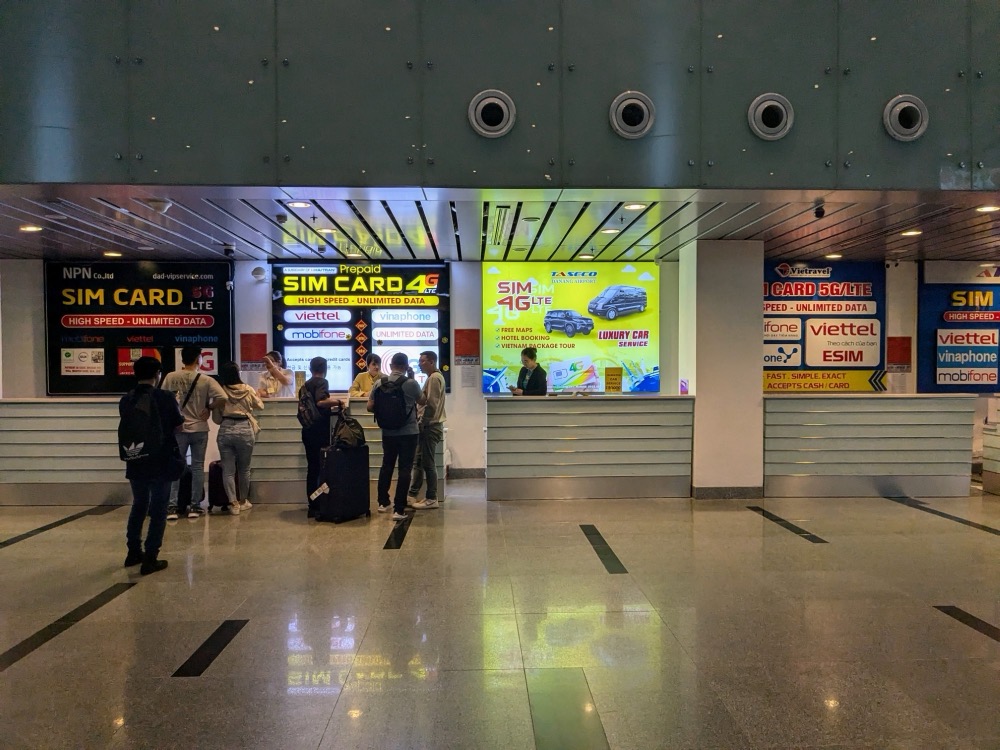
All three major airports (Noi Bai in Hanoi, Tan Son Nhat in HCMC, Da Nang) have SIM card kiosks in the arrivals hall. Staff will activate the card for you, which saves the hassle of doing it yourself. Prices are slightly higher than in town — expect to pay 50,000–100,000 VND more than you would at a street-level shop — but it’s worth it for the convenience, especially if you’re arriving late or need a number straight away for your transport booking.
Bring your passport. Registration is required by law for all SIM activations in Vietnam — the kiosk staff will need to photograph your ID page.
Mobile stores in town
Branded Viettel, VinaPhone, and MobiFone stores are easy to find on the main streets of any city. Prices are lower than at the airport, and staff can set up your APN settings if needed. If you’re in no rush, waiting until you get to town saves a little money and often gets you a better data package.
eSIM — buy before you land
If your phone supports eSIM (most phones from 2019 onward do), you can buy a Vietnamese eSIM before you board the plane and activate it on arrival. This is useful if you want data from the moment you land — useful for navigating the airport pickup or finding your transfer.
Check that your phone is unlocked and eSIM-compatible before purchasing. Two reliable options:
- Airalo — the most widely used eSIM marketplace, with Vietnam packages starting from around $5 USD for 1GB up to $17 for 10GB over 30 days. Straightforward app, instant delivery. Use code ESIMTRAVEL15 for 15% off your first order, or ESIMTRAVEL10 for 10% off if you’ve used Airalo before.
- Saily — a newer option with competitive pricing and a clean interface. Worth comparing against Airalo for your data needs.
Practical tips
- Passport required: Every SIM purchase in Vietnam requires ID. No passport, no SIM — this is enforced at kiosks and stores.
- Unlock your phone first: If your phone is carrier-locked, a Vietnamese SIM won’t work. Check with your home carrier before you travel.
- Top-ups: Available at VinMart, Circle K, FamilyMart, and most small phone shops. Tell the cashier your carrier and the amount — they’ll hand you a scratch card or credit it directly.
- Data speeds: All three carriers run 4G LTE in cities. In rural areas, you may drop to 3G — Viettel holds 4G the longest in mountain regions.
- Hotspot: Tethering works on all prepaid plans. Useful if you’re travelling with a tablet or laptop.
- Apps to install immediately: Grab (transport and food), Zalo (local messaging — most Vietnamese use this over WhatsApp), and Google Maps with Vietnam downloaded offline.
Which one should you get?
For most visitors: Viettel. It covers the widest range of destinations, the price is fair, and you won’t be second-guessing your signal in remote areas. If you’re spending the whole trip in Ho Chi Minh City or the Mekong, MobiFone is a solid alternative. VinaPhone is fine for Hanoi city breaks but I wouldn’t choose it for a multi-city trip.
If you want zero hassle, buy an eSIM from Airalo or Saily before you fly and switch to a physical Viettel card once you’re settled — the eSIM gives you coverage on arrival, the local card gives you a Vietnamese number for the rest of the trip.
Tours & activities in Vietnam
Activity links above are affiliate or partner links.