
Last updated: October 2026
If you want to see the whole country in one trip, the best time to visit Vietnam is March or April. Those are the months when Hanoi is warm but not yet steaming, the central coast around Hoi An and Da Nang is dry, and Ho Chi Minh City hasn’t started its rainy season. The wider window is November to April. The catch is that the central coast stays wet until about January.
Vietnam is about 1,650 km from north to south, and the north, the central coast and the south each run on a different weather calendar. So the honest answer to “when should I go?” is “where are you going?”. This guide covers each region, the rainy and typhoon seasons, every month of the year and the months I’d avoid.
My honest take: Vietnam weather in short
- Whole country in one trip: March or April. November to April works if you’re happy to accept some rain in Hue and Hoi An before January.
- Hanoi, Ha Long Bay, Ninh Binh: October and November are the best, with March and April next.
- Sapa and Ha Giang: September to November for clear trekking and the golden rice harvest. December to February nights can drop close to freezing.
- Hoi An and Da Nang: February to August. Hue: March to August.
- Ho Chi Minh City, the Mekong Delta and Phu Quoc: December to April.
- Months to avoid: October and November on the central coast (flood season), and the first days of Tet if you need buses, shops and restaurants to be open.
- Some part of Vietnam is always dry. Even in July you can have a great beach trip on the central coast.
Best time to visit Vietnam at a glance
North: Hanoi, Ha Long Bay, Ninh Binh
Best months: Oct–Nov, Mar–Apr
Rainy season: May–Sep
Temperatures: Hanoi highs about 20°C in Jan, 33–35°C in Jun–Aug
Northern mountains: Sapa, Ha Giang, Mu Cang Chai
Best months: Sep–Nov, Mar–May
Rainy season: May–Sep
Temperatures: Cool all year; winter nights can go below 0°C in Sapa
Central coast: Hue, Da Nang, Hoi An
Best months: Feb–Aug (Hue Mar–Aug)
Rainy season: Sep–Dec
Temperatures: Highs about 25°C in Jan, 34°C in Jun–Jul
South-central coast: Quy Nhon, Nha Trang
Best months: Feb–Aug
Rainy season: Oct–Dec
Temperatures: Nha Trang highs about 27°C in Dec–Jan, 32–33°C in May–Aug
Central Highlands: Da Lat
Best months: Dec–Mar
Rainy season: May–Oct
Temperatures: Highs 21–25°C, nights 12–16°C
South: Ho Chi Minh City, Mekong Delta
Best months: Dec–Apr
Rainy season: May–Nov
Temperatures: Highs 32–35°C all year
Phu Quoc
Best months: Dec–Mar
Rainy season: May–Oct
Temperatures: Highs 30–32°C
Connect and book directly with local licensed tour operators at tour.vietnam-guides.com

Northern Vietnam: Hanoi, Ha Long Bay, Ninh Binh and the mountains
The north has real seasons. Winter (December to February) is grey and cool: Hanoi averages highs around 20°C and lows around 14°C in January. Houses and most cheap hotels have no heating, so 14°C feels colder than it sounds. It’s mostly dry, though: December and January get about 20 mm of rain in Hanoi.
Summer (June to August) is the opposite: highs of 33–35°C, heavy humidity and 250–275 mm of rain a month, usually as short, violent storms. That’s also when storms are most likely to stop Ha Long Bay cruises. Spring is short and drizzly (March in Hanoi has about 16 days with rain, but only 36 mm in total). Autumn is the best time: October still reaches 30°C, November about 27°C, and the rain drops from 155 mm to around 60 mm.
Best months for Hanoi, Ha Long and Ninh Binh: October to November, then March to April. For the details, see Hanoi in November, Ha Long in October and Ninh Binh in April.
→ See Ha Long Bay and Lan Ha Bay cruise options
Sapa, Ha Giang and Mu Cang Chai
The mountains are a different story. Sapa sits at around 1,500 m and gets 2,000–2,500 mm of rain a year, most of it from May to September, when trails turn to mud and the clouds hide the views. Winter is dry but cold. Temperatures occasionally fall below freezing, and snow has been recorded on the higher slopes. September to November is the sweet spot for trekking and for the Ha Giang loop, with March to May the second-best window.
The rice terraces turn gold from mid-September to early October, and the last week of September is the safest bet in Mu Cang Chai and Sapa. Hoang Su Phi in Ha Giang follows roughly the same timing. By mid-October the harvest is mostly over. Our golden rice season guide has the week-by-week timing.
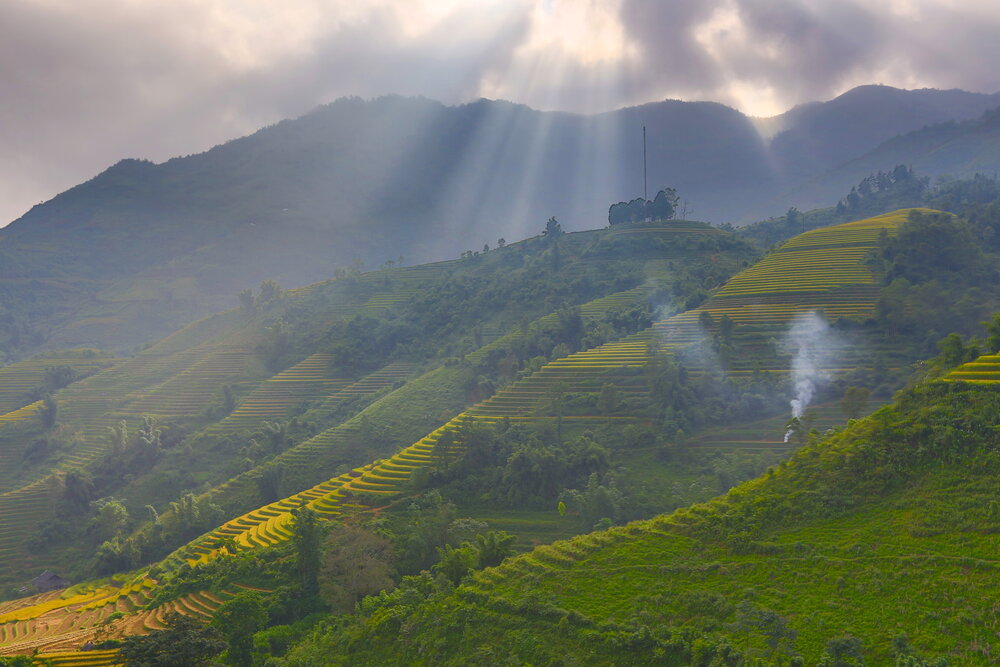
Avoid for the mountains: December to February, unless you’ve packed proper warm layers. July and August are wet, but the terraces are green then and the crowds are thin.
Central Vietnam: Hue, Da Nang, Hoi An and Phong Nha
The central coast has a wet season that runs opposite to the rest of the country. While Hanoi and Saigon dry out in October and November, Da Nang gets its heaviest rain: about 630 mm in October and 450 mm in November, compared with roughly 25 mm a month from February to April. Hue is wetter still, with about 770 mm in October, 640 mm in November and 350 mm in December, and it stays showery into January.
That’s why the advice differs within the region. Da Nang and Hoi An are at their best from February to August. Hue is better from March to August. June to August is hot, with highs around 34°C, but it’s proper beach weather, and the sea is calm.
In October and November, Hoi An’s riverside streets often flood, and roads around Hue and Hoi An can be cut for days after big storms. In late October 2025, record rain (more than 1,000 mm in 24 hours near Hue) put parts of Hoi An’s old town under up to 2 m of water. It reopened to visitors in early November. In Phong Nha, Oxalis only runs Son Doong expeditions from January to August. Paradise Cave and Phong Nha Cave stay open in the wet season, but close for a few days at a time when the river floods.

Our honest take: a lot of people plan a north-to-south trip in November or December and then lose two days in Hoi An to rain. If those are your months, keep the central coast short, or do it last in January or later.
Quy Nhon and Nha Trang
Further south, the rainy season starts later and is shorter. Quy Nhon and Nha Trang are dry from about February to August and wet from September or October to December, with October and November the worst. Typhoon Kalmaegi tore roofs off in Quy Nhon in early November 2025. From about January to August the sea is calm enough for boat trips to the islands. For the details, see Nha Trang’s rainy season at its worst in October, or Nha Trang in February for the dry season.

Da Lat
Da Lat sits at 1,500 m in the Central Highlands. It never gets hot: highs are 21–25°C all year, and nights drop to 12–16°C, so bring a jacket. The dry season runs from December to March (January averages just two rainy days). From May to October it rains on 20–24 days a month, usually in the afternoon.
Southern Vietnam: Ho Chi Minh City, the Mekong Delta and Phu Quoc
The south has two seasons and no winter. Ho Chi Minh City reaches 32–35°C all year. From December to April it’s dry, with under 20 mm of rain a month from January to March, and April is the hottest month. The rainy season runs from May to November. Most days that means a heavy storm in the afternoon or evening and a clear morning, so it rarely ruins a city trip.
The Mekong Delta has its own high-water season, the “floating season”, from about August to November, when the rivers rise and the low fields flood. It’s an interesting time to see the delta, with seasonal fish and flood-season dishes on the menu.
Phu Quoc is best from December to March, when it gets about 27 mm of rain a month in January and February. From May to October it gets 280–485 mm a month and rain on about 20 days. The southwest monsoon also makes the sea rough on the west coast, and boat trips to the southern islands get cancelled. You can still go then if you’re after cheap rooms, but don’t count on beach days. Con Dao is dry from November to April. March and April are the best months if you want to dive, because the sea is calm and the water is clear.

When is the rainy season in Vietnam?
There isn’t one rainy season for the whole country. There are two, and they’re at different times of year:
- North and south (Hanoi, Sapa, Ho Chi Minh City, the Mekong Delta, Phu Quoc, Da Lat): May to October. In the south it often runs into November.
- Central coast (Hue to Nha Trang): September to December, with the heaviest rain in October and November. Hue and Da Nang stay showery into January.
The dry season is the mirror image: November to April in the north and south, and about February to August on the central coast. In the north, the “dry” winter is also cool and grey, so the best weather is in the transition months either side: October to November and March to April.
The rainy season doesn’t mean all-day rain. In Hanoi and Ho Chi Minh City, a typical wet-season day has a heavy downpour for an hour or two, then sun. The central coast is the exception: a storm there can mean several days of steady rain and flooding.
When is typhoon season in Vietnam?
Typhoons and tropical storms can hit Vietnam from about June to November. They tend to reach the north earlier in the season (July to September) and the central coast later (September to November). The season moves from north to south, and September has the most landfalls. The coast from Quang Ninh (Ha Long Bay) to Thanh Hoa is hit most often, and the far south rarely. Super Typhoon Yagi hit northern Vietnam in September 2024, and Kalmaegi made landfall near Quy Nhon in November 2025.
If you’re travelling in these months, get travel insurance that covers weather delays, and keep a spare day around Ha Long Bay cruises and island trips. The authorities close the bay when a storm is coming, and the cruise companies then cancel or move the trip.
Vietnam weather month by month
January: Ho Chi Minh City, Phu Quoc and the Mekong Delta are at their best. Hanoi is grey and cool (highs around 20°C), and Sapa is cold. Hue and Da Nang are drying out but still showery. Busy in the run-up to Tet. More in Vietnam in January.
February: dry and warm in the south. Da Nang and Hoi An enter their dry season (about 24 mm of rain in Da Nang), and the north starts to warm up. Tet falls on 6 February in 2027 (the holiday runs roughly 4–10 February), so book transport early. See Vietnam in February.
March: the best month for the whole country in one trip. The south is dry and the central coast is dry. Hanoi warms up to around 26°C, with a lot of light drizzle but little real rain. See Vietnam in March.
April: warm everywhere. It’s the hottest month in Ho Chi Minh City, beach season starts on the central coast, and it’s good trekking weather in Sapa and Ha Giang. Expect domestic crowds around the 30 April–1 May holidays. See Vietnam in April.
May: the south’s rainy season starts. The central coast is excellent, and the north is hot (highs around 33°C). Da Lat turns wet. See Vietnam in May.
June to August: head for the central coast. Da Nang, Hoi An, Quy Nhon and Nha Trang are hot and mostly dry. Hanoi is at 33–35°C with heavy storms, and Ha Long cruises get cancelled more often in July and August. The south and Phu Quoc are in their wet season. Vietnamese school holidays fill the beach towns. See June, July and August.
September: the north clears up later in the month, and the rice terraces turn gold. The central coast’s rains begin (Da Nang about 350 mm). There’s a public holiday on 2 September. See Vietnam in September.
October: the north is at its best, with clear skies and highs around 30°C in Hanoi. This is the central coast’s wettest month, so skip Hue and Hoi An or keep plans flexible. The south’s rains ease toward the end of the month. See Vietnam in October.
November: Hanoi is lovely (highs around 27°C, little rain) and the south dries out. The central coast is still in flood season: Hue averages over 600 mm in November. See Vietnam in November.
December: Phu Quoc and the south are in peak season. Hanoi is cold and grey (highs around 21°C, lows around 14°C), and the mountains are colder still. Hue still has rain on about 20 days. A good month for a south-and-north trip that skips the middle. See Vietnam in December and our Christmas in Vietnam ideas.

Average high and rainfall by month
Average daily high temperature and monthly rainfall. Long-term averages from the Vietnam Institute for Building Science and Technology (Hanoi: 1991–2020 normals).
Hanoi: average high and rainfall
| Month | High °C | Rain mm |
|---|---|---|
| Jan | 20 | 20 |
| Feb | 22 | 20 |
| Mar | 26 | 36 |
| Apr | 29 | 104 |
| May | 33 | 165 |
| Jun | 35 | 264 |
| Jul | 34 | 254 |
| Aug | 33 | 274 |
| Sep | 32 | 228 |
| Oct | 30 | 155 |
| Nov | 27 | 61 |
| Dec | 21 | 20 |
Hue: average high and rainfall
| Month | High °C | Rain mm |
|---|---|---|
| Jan | 24 | 129 |
| Feb | 25 | 63 |
| Mar | 28 | 51 |
| Apr | 31 | 59 |
| May | 34 | 111 |
| Jun | 35 | 103 |
| Jul | 35 | 95 |
| Aug | 34 | 139 |
| Sep | 32 | 411 |
| Oct | 29 | 773 |
| Nov | 27 | 642 |
| Dec | 24 | 350 |
Da Nang: average high and rainfall
| Month | High °C | Rain mm |
|---|---|---|
| Jan | 25 | 82 |
| Feb | 26 | 24 |
| Mar | 28 | 25 |
| Apr | 31 | 35 |
| May | 33 | 81 |
| Jun | 35 | 83 |
| Jul | 34 | 93 |
| Aug | 34 | 141 |
| Sep | 32 | 351 |
| Oct | 30 | 628 |
| Nov | 27 | 448 |
| Dec | 25 | 218 |
Da Lat: average high and rainfall
| Month | High °C | Rain mm |
|---|---|---|
| Jan | 22 | 9 |
| Feb | 24 | 21 |
| Mar | 25 | 64 |
| Apr | 25 | 170 |
| May | 25 | 212 |
| Jun | 24 | 204 |
| Jul | 23 | 233 |
| Aug | 23 | 238 |
| Sep | 23 | 283 |
| Oct | 23 | 245 |
| Nov | 22 | 94 |
| Dec | 21 | 36 |
Phu Quoc: average high and rainfall
| Month | High °C | Rain mm |
|---|---|---|
| Jan | 31 | 28 |
| Feb | 31 | 27 |
| Mar | 32 | 61 |
| Apr | 33 | 148 |
| May | 32 | 281 |
| Jun | 30 | 382 |
| Jul | 30 | 419 |
| Aug | 30 | 486 |
| Sep | 30 | 474 |
| Oct | 30 | 354 |
| Nov | 31 | 164 |
| Dec | 30 | 59 |
Months to avoid in Vietnam
No month is a write-off for the whole country, but some places are best skipped at certain times:
- The central coast in October and November (and Hue into December): the heaviest rain, flood risk and storms.
- Ha Long Bay in July and August: the most cruise cancellations, plus heat and humidity.
- Phu Quoc from June to September: rough seas and cancelled boat trips.
- The northern mountains from December to February, unless you’re ready for near-freezing nights.
- The first three to five days of Tet: many shops, restaurants and museums close, and buses and trains sell out. The weeks around it are fine. Read our guide to travelling during Tet before you book.
Best time for beaches in Vietnam
Pick the coast to match the month. From December to April, go south: Phu Quoc, Con Dao and Mui Ne. From February to August, the central coast is the place: Da Nang, Hoi An’s An Bang beach, Quy Nhon and Nha Trang. The northern coast (Cat Ba, Ha Long Bay) only works for swimming from about May to August, and the water is cold in winter. Our Vietnam beaches and islands guide covers each beach in detail.
Best time to see the rice terraces
The terraces in Sapa, Mu Cang Chai and Ha Giang go through three looks a year. In May and June they’re flooded for planting, and the water reflects the sky. From July to August they’re bright green. From mid-September to early October they turn gold just before the harvest. Most photographers aim for the golden weeks, so book hotels in Mu Cang Chai and Sapa early for late September. Our rice terraces guide has the details by area.

→ Browse rice terrace trekking tours
FAQ
What is the best month to visit Vietnam?
March is the best single month for a trip that covers the north, the central coast and the south, with April a close second. If you’re only visiting one region, it depends where: October to November for Hanoi and the north, February to August for Hoi An and Da Nang, and December to April for the south.
When is the rainy season in Vietnam?
May to October in the north and south, and September to December on the central coast between Hue and Nha Trang. October and November are the wettest months in Hue, Da Nang and Hoi An.
Is July or August a bad time to visit Vietnam?
Not if you plan around it. The central coast (Da Nang, Hoi An, Quy Nhon, Nha Trang) is hot and mostly dry in July and August, which makes it a good beach trip. The north is very hot with heavy storms, and the south has afternoon rain.
Does it get cold in Vietnam?
Yes, in the north from December to February. Hanoi averages lows around 14°C, and nights in Sapa and Ha Giang can drop close to or below freezing. Da Lat is cool all year. The south never gets cold.
When is typhoon season in Vietnam?
From about June to November. Storms tend to hit the north from July to September and the central coast from September to November. If you’re travelling then, leave a spare day around boat trips and get insurance that covers weather delays.
Should I travel Vietnam north to south or south to north?
Plan the direction so you reach the central coast in its dry season. From October to December, start in the north and finish in the south, and keep Hoi An short. From February to April, either direction works.
Vietnam weather by month
Planning around a specific month? Choose below for a detailed regional breakdown:

Read more: 1-week Vietnam itinerary · 2-week Vietnam itinerary · Ha Long Bay vs Lan Ha Bay · Vietnamese festivals and public holidays
Tours & activities in Vietnam
Activity links above are affiliate or partner links.