
Late September and early October bring one of Vietnam’s most photographed moments — the rice harvest. Terraces across the northern mountains turn from green to gold as the paddies ripen, and the effect on the right hillside can stop you mid-walk. The window is short, usually three to four weeks, and it doesn’t happen everywhere at once. Here’s where to go and what to expect.
Why rice terraces matter here
Vietnam’s northern highlands are home to dozens of ethnic minority communities — H’Mong, Red Dao, Tay, Ha Nhi, La Chi, Muong, Thai, and others — who carved these terraces out of steep mountainsides over centuries. The paddies aren’t a tourist attraction that grew into farmland. They’re working farmland that happens to be extraordinarily beautiful.
Vietnamese folklore holds rice as a sacred gift, and the harvest remains a communal event in most terrace villages. Visiting during the golden season means you’re arriving at one of the most important moments in the agricultural and cultural calendar of these communities.
The three seasons worth knowing
Most visitors only think about the golden harvest, but the terraces are worth seeing across three distinct windows:
- Water-pouring season (May–June): Fields are flooded ahead of planting. On clear mornings the terraces become mirrors, reflecting the sky. Mu Cang Chai and Hoang Su Phi are particularly striking at this time. Crowds are minimal.
- Green season (July–August): The terraces are lush and intensely green. Not the Instagram moment but genuinely beautiful — and far quieter than September. Higher humidity and occasional rain.
- Golden harvest (mid-September–early October): The peak. Fields turn gold from the highest elevations down. The three-to-four week window varies by location and altitude each year.
Pu Luong is the only major location with two annual crops — meaning you can catch both the water-pouring and golden seasons in a single year if your timing is right.
When the golden season happens
The harvest ripens from high altitude to low, meaning the exact timing shifts by location and elevation. As a rule of thumb:
- Mid-September: High-altitude terraces in Mu Cang Chai and Y Ty begin turning
- Late September: Peak colour at most northern mountain locations — Sapa, Hoang Su Phi, Pu Luong
- Early October: Most mountain terraces already being cut; harvest largely wrapping up at higher elevations
- Mid-October: Harvest largely over in most locations
The safest approach is to target the last week of September if you can only choose one window. That catches most locations near their peak simultaneously. Contact your accommodation 5–7 days before arrival to ask which fields are currently ripest — guesthouses at terrace locations track this closely.
→ Browse rice terrace trekking tours
Mu Cang Chai
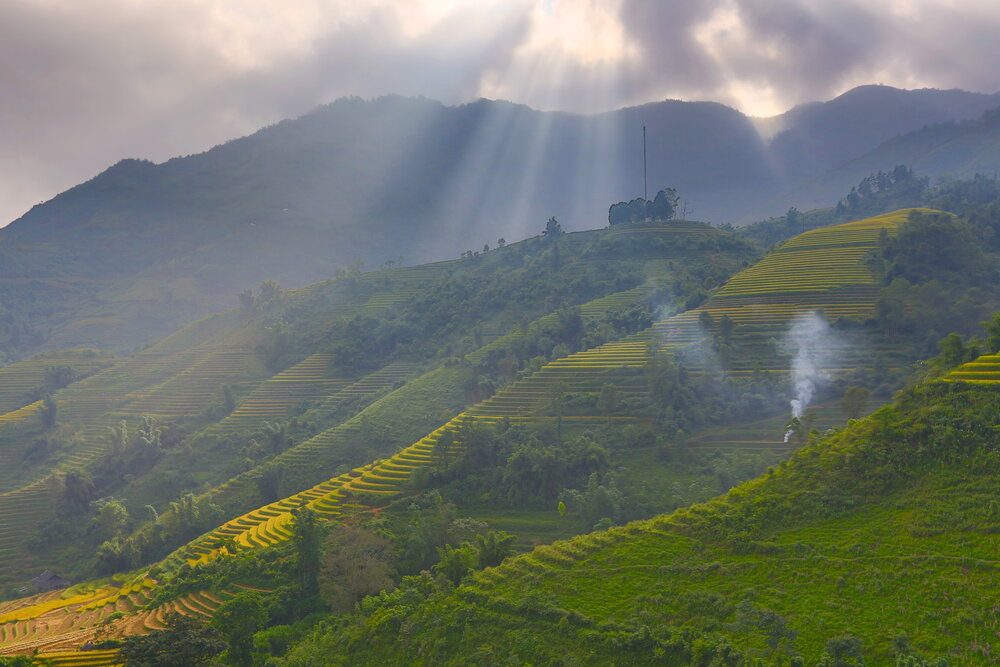
If you’re going to one place for golden rice, make it Mu Cang Chai. The terraces here cover around 2,200 hectares across three main communes — La Pan Tan, Che Cu Nha, and De Xu Phinh — with 500 hectares designated as a national scenic heritage site. The scale is unlike anything in Sapa or Ninh Binh. The hillsides are steep and uninterrupted, so sunrise from above La Pan Tan gives you a sea of gold dropping into the valley below.
The terraces were built and are still farmed by H’Mong families — a community that has been working these slopes for more than 20 generations. The engineering involved is remarkable: water is channelled from mountain streams through a system of bamboo pipes and channels, flooding each terrace tier in sequence during planting season.
Mu Cang Chai is around 280km from Hanoi — about 6 hours by bus or 5 hours driving. The town itself is small; stay here rather than day-tripping from elsewhere. Most photographers arrive the afternoon before to scout positions for sunrise.
The best viewpoints are above the road between La Pan Tan and De Xu Phinh. You don’t need a guide to find them — the main road runs along the ridge — but a motorbike lets you move between spots quickly as light changes.
→ Browse rice terrace trekking tours
Y Ty
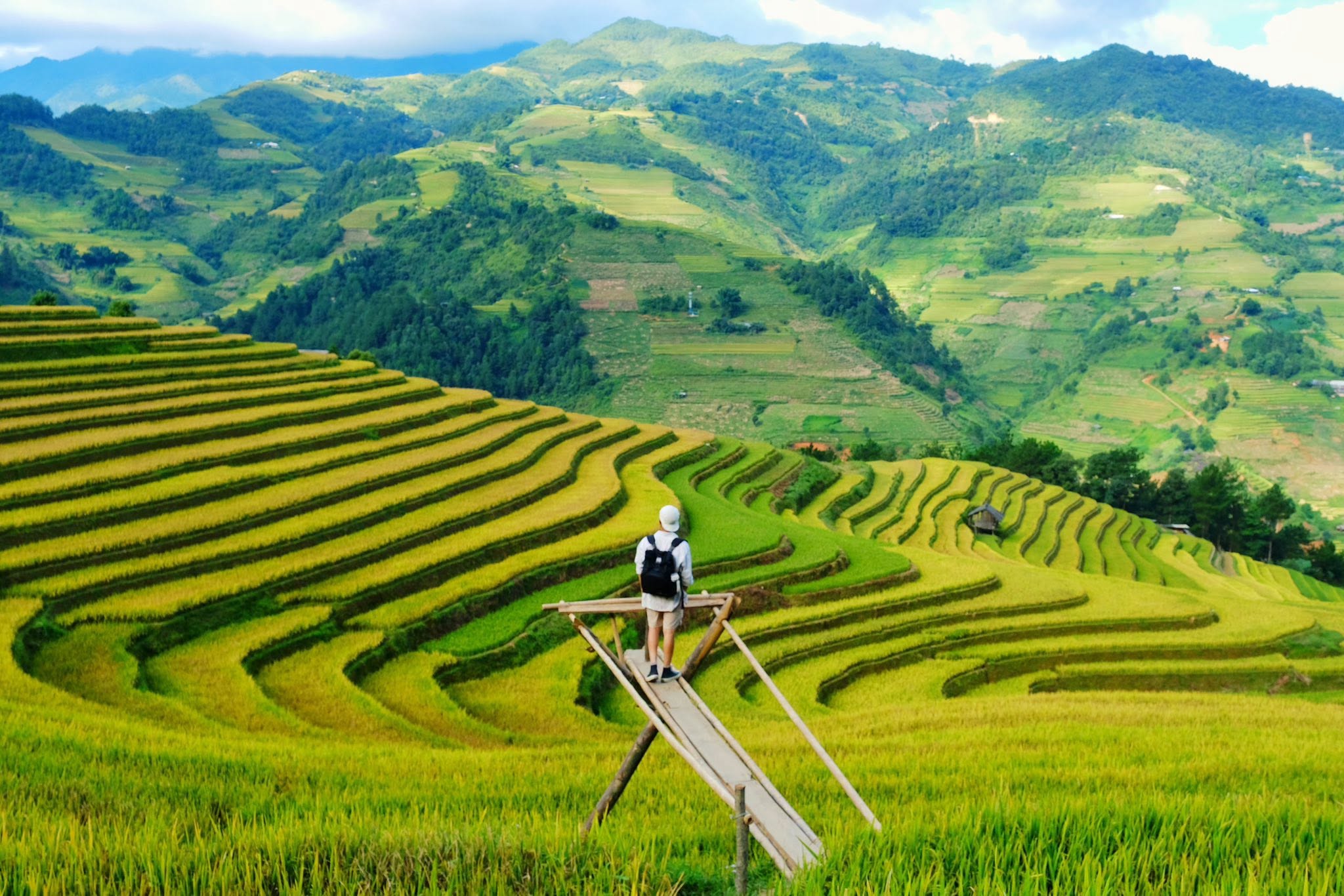
Y Ty sits at over 2,000 metres in the northeast highlands of Lao Cai province, about two hours from Sapa. It’s one of the least-visited major terrace destinations — infrastructure is minimal, crowds are non-existent, and the scenery is exceptional.
The Ha Nhi people have farmed these slopes for generations and still wear traditional dress daily. Their homes are distinctive: thick clay walls with thatched roofs, built to withstand the altitude’s cold winters. Y Ty is known locally as a “cloud hunting” destination — on clear mornings in early October the terraces appear to float above a sea of low cloud.
The peak at Nhiu Co San above Y Ty reaches 2,700 metres. There’s a weekly Saturday market where multiple ethnic groups from surrounding villages come to trade — a genuine community event worth timing your visit around.
Best visited in May (water-pouring season, mirror-like fields) or late September to early October (golden harvest, earlier than Sapa due to higher elevation).
→ Browse rice terrace trekking tours
Hoang Su Phi
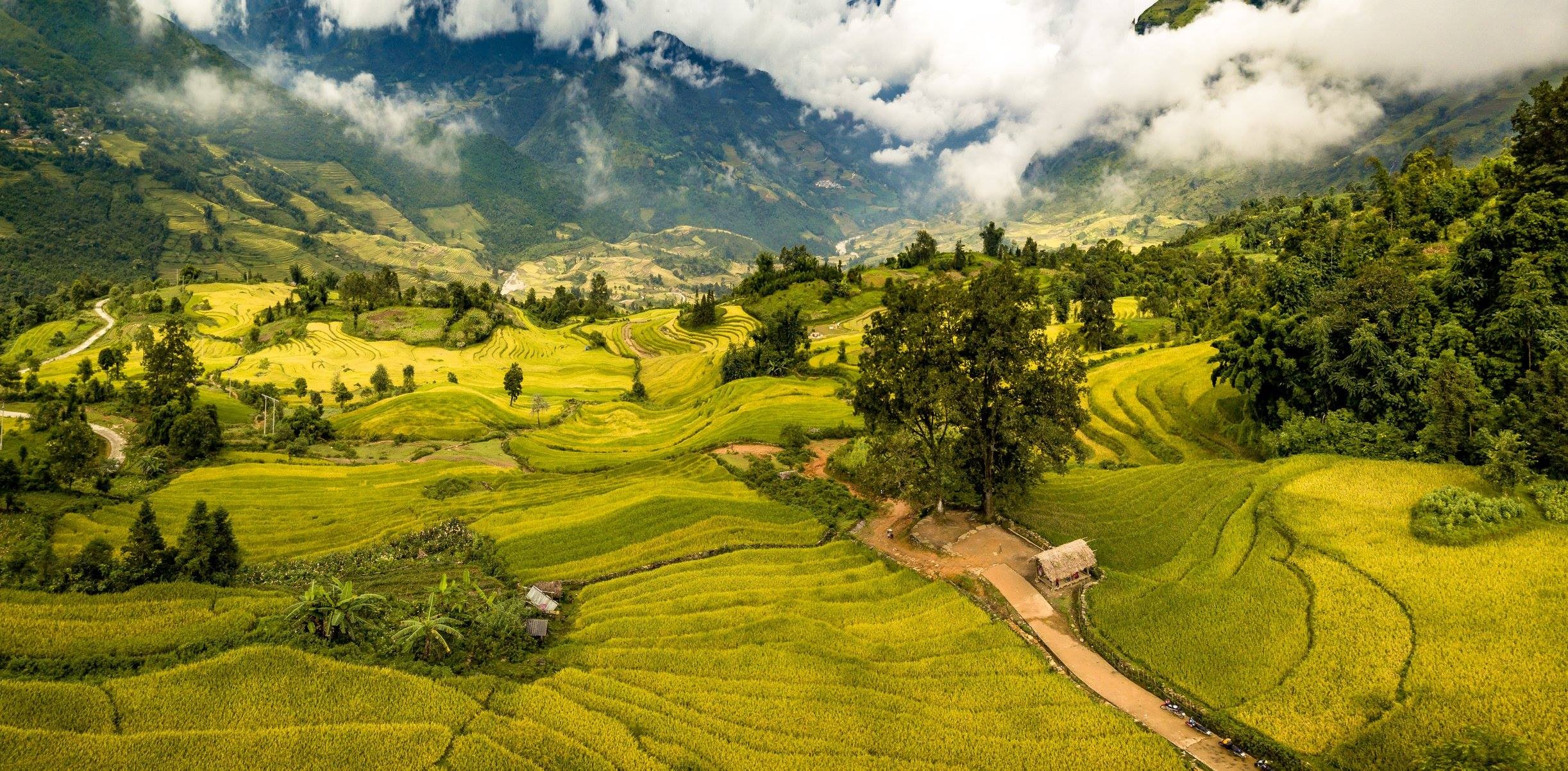
Ha Giang province’s Hoang Su Phi district sits at a lower profile than Mu Cang Chai but rewards those who make the trip. The terraces here cover over 3,700 hectares across a landscape divided by mountains descending toward the Lo River — wide, open valleys with narrow terrace steps cut into the hillsides by La Chi and Dao ethnic communities.
Hoang Su Phi has been recognised as a national heritage landscape since 2012. It remains genuinely off the tourist radar — far less commercialised than Sapa, with authentic village life and forest-integrated landscapes. Different ethnic villages here observe slightly different planting schedules, which means the golden season spreads over a longer window than in more homogeneous areas.
Getting here from Hanoi takes around 7–8 hours. The town of Vinh Quang is the base; from there you can reach the main terrace villages of Ban Luoc and Thong Nguyen in under an hour. The water-pouring season (March–May) is also worth considering here — the flooded terraces catch the sky beautifully. September and early October are the only reliable months for the golden harvest. See our Ha Giang guide for more on getting there.
→ Browse rice terrace trekking tours
Sapa and the Muong Hoa Valley
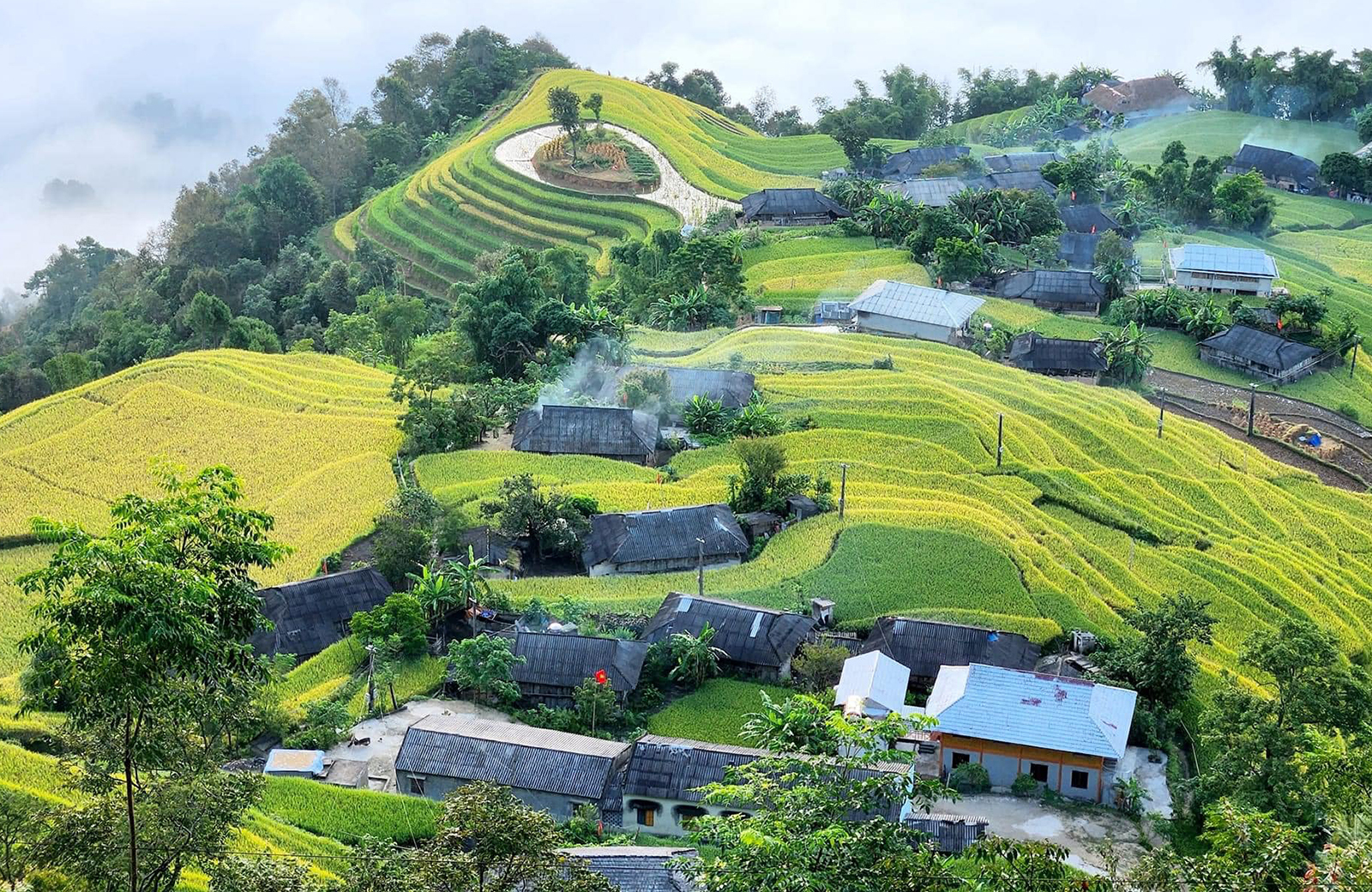
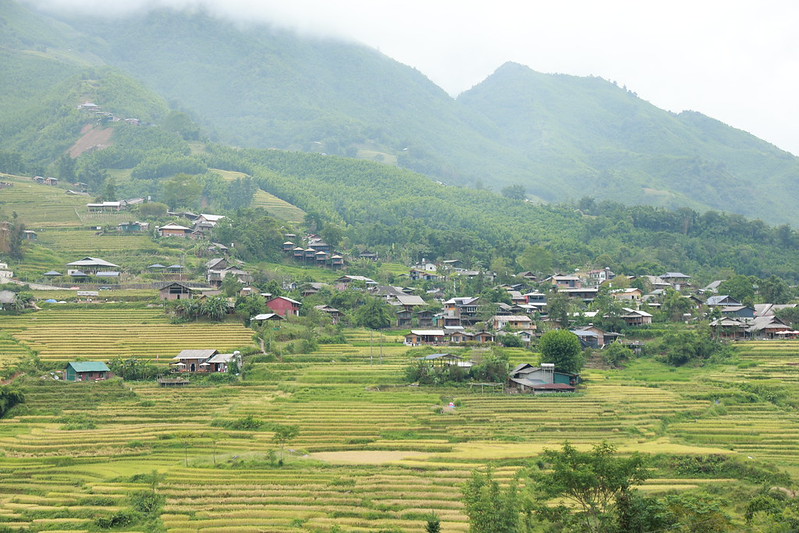
Sapa’s terraces in the Muong Hoa Valley are the most accessible northern option — direct overnight trains from Hanoi, a well-established guesthouse scene, and village trekking routes that have been running for decades. The terraces were first carved around the 15th century and are still actively farmed by Black H’Mong and Red Dao families. The downside is the crowds. Sapa town in late September fills with photographers, and the most-photographed spots near Ta Van and Lao Chai villages can feel crowded by 7am.
The terraces themselves are genuinely impressive — the Muong Hoa Valley drops steeply from Sapa town and the scale of the farming is real, not a set piece. Go for the trekking as much as the photos; walking between Black H’Mong villages through the ripening paddies is the better experience. Ethnic village homestays are the best way to stay — they place you directly in the terrace landscape and give you genuine interaction with the farming families.
Early morning and late afternoon light are the only times the terraces photograph well — midday is flat. The best season for photography is mid-August to early September (pre-harvest, clear skies, lush green) or late September (golden peak). See our Sapa travel guide for the full picture on getting there and what to do.
→ Browse rice terrace trekking tours
Pu Luong
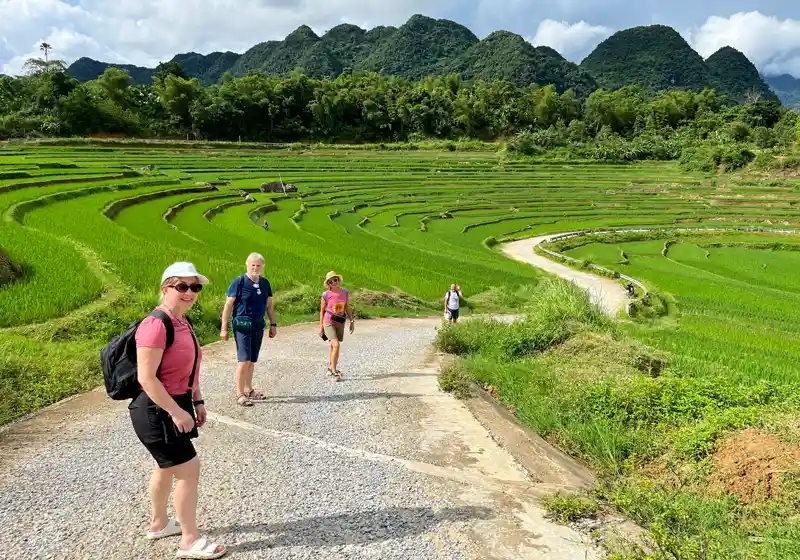
Pu Luong in Thanh Hoa province is the least-visited of the main golden rice destinations and the most accessible from Hanoi at around 150–160km (roughly 4 hours). The terraces here run along a narrow valley floor in Ba Thuoc District rather than clinging to steep hillsides, giving a different visual — flatter, more expansive, with stilted Muong and Thai villages dotting the fields.
Uniquely, Pu Luong supports two annual rice crops. That means you can visit during both the water-pouring season and the golden harvest in the same year — something no other major terrace destination offers. The scale is smaller than Mu Cang Chai but the crowds are a fraction of Sapa’s, and the tropical forest backdrop adds texture that the high-altitude locations lack.
Two or three nights is enough to cover the main valleys. Stilt-house guesthouses right on the terrace edge make it easy to shoot dawn and dusk without moving far. Read our full Pu Luong travel guide for accommodation and trekking options.
→ Browse rice terrace trekking tours
Tam Coc, Ninh Binh
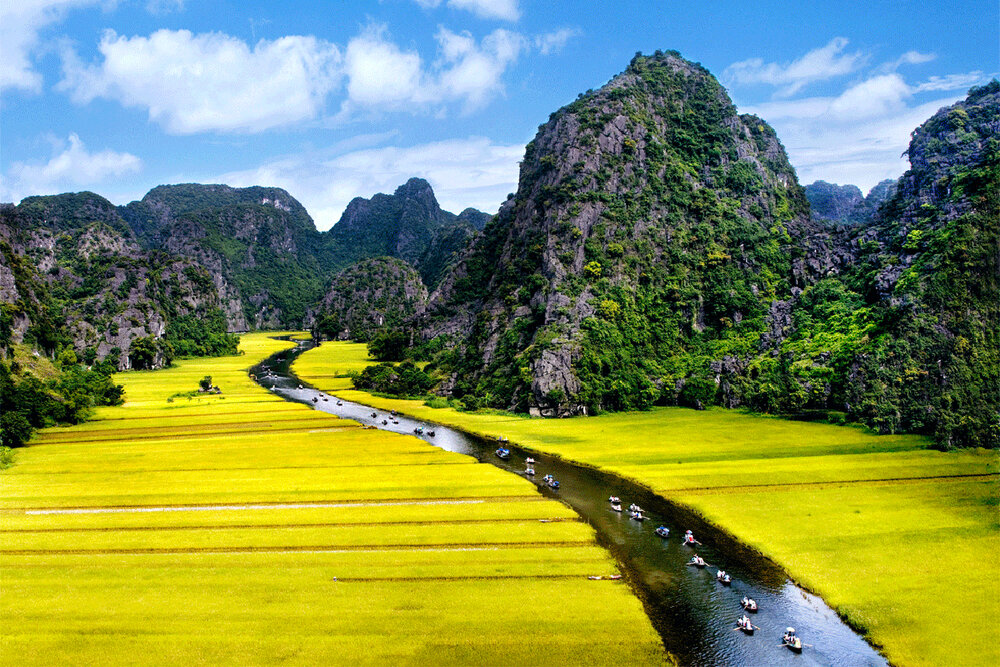
Tam Coc works differently from every other location on this list. The paddies here are flat and low, threaded by the Ngo Dong River and framed by limestone karst outcrops — and unlike the northern mountain terraces which harvest in September–October, Tam Coc’s golden season falls in late May to mid-June. The spring crop ripens then, and the boat trips through the golden paddies — hand-paddled by local women using their feet to work the oars — become a genuinely good photography experience rather than just a tourist ride.
This is worth knowing if you’re planning around the rice season: Tam Coc and the northern mountain terraces don’t overlap. If you want both, you need two separate trips or a very long one.
Ninh Binh is 100km from Hanoi, reachable in 2 hours by train. It works as a day trip, but staying overnight means you can get on the river at 7am before the tour groups arrive. Late May and early June are the sweet spot. See our Ninh Binh travel guide for where to stay and what else to see.
→ Browse rice terrace trekking tours
Ban Lac, Mai Chau
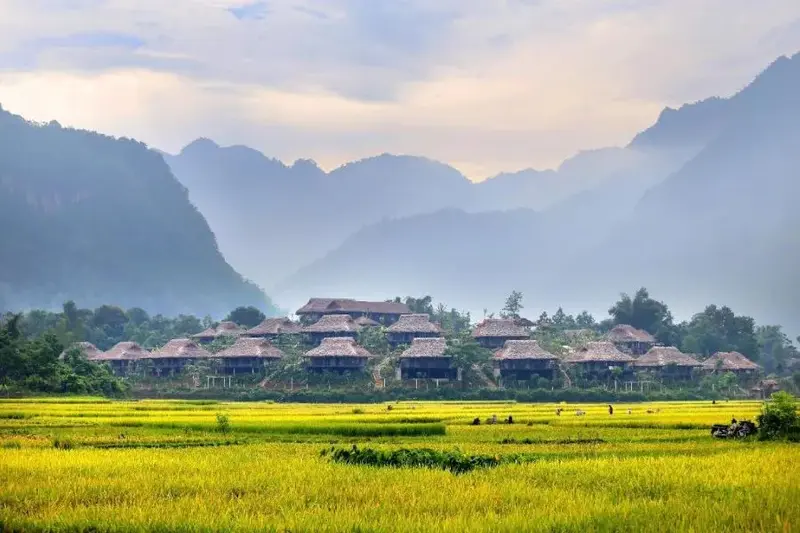
Mai Chau valley in Hoa Binh province sits around 140km from Hanoi — roughly 3 hours by bus or car, making it the most accessible terrace destination on this list. The White Thai community has farmed the valley floor here for generations, and the landscape is gentler than the steep northern mountain terraces: wide flat paddies surrounded by forested limestone hills and limestone outcrops, dotted with traditional stilt houses.
Ban Lac is the main village and the best base. Stilt-house homestays sit right at the edge of the fields — warm, welcoming, and run by White Thai families who have been hosting travellers for decades. The community is also known for its skilled weavers, who work ancient looms to produce intricate fabrics. The Sunday morning market draws ethnic minority groups from surrounding villages in traditional dress — worth timing your visit around if you can.
The terraces here aren’t the dramatic vertical stacking of Mu Cang Chai, but the valley-floor scale is wide and the setting genuinely peaceful. Two seasons are worth targeting:
- March–May: Fields are flooded and planted — vivid green paddies stretching across the valley, good cycling weather, far fewer visitors than September
- September–October: Harvest season, golden fields, White Thai farmers cutting rice by hand. October is the peak — avoid June to August when monsoon flooding closes some valley paths
From Ban Lac you can hire a bicycle and cycle the flat lanes between villages and fields in a couple of hours. Electric carts are also available for inter-village trips. Day treks to Hoa Binh Lake or into the edge of Pu Luong Nature Reserve — with streams, waterfalls, and forest — are easy to arrange through your homestay. See our Mai Chau travel guide for where to stay and how to get there.
Mai Chau is a popular weekend trip from Hanoi. Arrive on a weekday if you want the valley to yourself.
→ Browse rice terrace trekking tours
Photography tips
- Arrive before 7am: The best spots at Mu Cang Chai and Sapa fill with photographers quickly. Being in position before sunrise is non-negotiable during peak golden season.
- Shoot early and late: Golden hour (6–8am and 4–6pm) is when the terrace colours show properly. Midday sun bleaches the gold out and creates harsh shadows in the terrace steps.
- Find elevation: The best terrace shots come from above. At Mu Cang Chai the road runs along the ridgeline; at Sapa you need to hike up from the valley floor.
- Include people: Farmers working the harvest — cutting rice by hand, carrying bundles on bamboo poles — make the images work. Most farmers are used to photographers but gesture for permission first and don’t photograph without consent.
- Stay off the fields: Walk only on the raised earth paths between paddies. Stepping onto a cultivated terrace damages the crop and the irrigation channels — both a practical and a cultural issue.
- Check before you go: Contact your accommodation 5–7 days before arrival to confirm current field conditions. A heavy rain can delay the golden turn; an early warm spell can advance it by a week.
- Drone rules: Drones require permits in Vietnam and are banned near airports and military zones. Check the current drone regulations before bringing one.
Practical notes
- Book well ahead: Accommodation in Mu Cang Chai, Sapa, and Pu Luong fills 4–6 weeks out for the last week of September.
- What to wear on the terraces: Strong-grip shoes or hiking boots are essential — the narrow earth paths between paddies are slippery even in dry conditions. Bring a layer; mountain temperatures can drop to 15°C at elevation even during golden season.
- Weather risk: Late September can bring typhoon-related rain that wipes out the harvest window. Build in a buffer day if your dates are tight.
- Motorbike access: At Mu Cang Chai and Hoang Su Phi, a motorbike is the only practical way to reach the best viewpoints. The terrace roads are narrow and the spots spread over 10–20km.
- Local guides: At Hoang Su Phi, a guide is useful for knowing which fields are ripest on a given day. At Y Ty, a guide helps with the cultural context of Ha Nhi village life.
- Respect the communities: These are working farms, not set pieces. Ask before photographing people, stay on the paths, and buy from local vendors where you can.
Tours & activities in Vietnam
Activity links above are affiliate or partner links.