
Few landscapes in Southeast Asia are as immediately arresting as the rice terraces of northern Vietnam — thousands of carved steps climbing steep mountain slopes, flooded to a mirror finish in May or blazing gold in September’s harvest light. They are not decorative features. They are working agricultural fields, hand-built over centuries by H’mong, Thai, Dao, Ha Nhi, and Muong farmers who had no flat land and made their own. Understanding this — that you are visiting a living farming system, not a scenic park — is the starting point for enjoying them properly.
Overview: What Makes Vietnam’s Rice Terraces Special
Vietnam’s rice terraces are concentrated almost entirely in the northern mountain region, where the topography made flat-field rice farming impossible. The terraces begin in Pu Luong (4 hours from Hanoi) and extend northward through Sapa, Mai Chau, Mu Cang Chai, Hoang Su Phi, Ha Giang, and the remote northeastern borderlands near Y Ty — a crescent of mountain provinces covering some of the most dramatic highland scenery in mainland Southeast Asia.
What distinguishes the Vietnamese terraces from those of Bali or the Philippines is their integration with ethnic minority village life. The farmers who tend these fields still live in the villages on the slopes above them; the terracing system is still managed communally; and the harvest — in most areas — is still done by hand. Visiting the terraces means moving through an active agricultural and social landscape, not a heritage site.
The terraces follow a seasonal cycle that drives their visual character completely. The same terrace looks entirely different in May (flooded, sky-reflecting), August (lush green), September–October (gold at harvest), and December (bare, brown, quiet). Choosing the right month for the experience you want is the single most important planning decision.
Best Time to Visit Vietnam’s Rice Terraces
There is no single “best” month — the terraces are beautiful across multiple phases, and each phase has a different visual quality. The two peak seasons are the water-filling season (May–June) and the harvest season (September–October).
May–June: Mirror-Water Season
After the winter fallow, farmers flood the terraces in preparation for planting — the stepped fields fill with water and reflect the sky, the clouds, and the surrounding mountain peaks in a series of mirrors stacked up the hillside. This is the most photogenic phase for landscape photography: the reflections, the geometry of the terrace walls against the water, and the early summer light give a quality that the harvest season, though more famous, doesn’t always match. Hoang Su Phi and Y Ty are particularly stunning in the water-filling phase. Sapa and Mu Cang Chai are excellent too. Rain is possible in May–June (the wet season is beginning) but the showers are typically afternoon events rather than all-day rain.
July–August: Deep Green Season
The rice plants are fully grown in July–August — the terraces are densely green, lush, and at their most vigorous. The green season is less famous than harvest but genuinely beautiful: the stepped hillsides look like a vast botanical garden, and the contrast between the deep green of the rice and the mountain sky (when it clears) is excellent. Rain is more frequent in July–August, particularly in Mu Cang Chai and Sapa, but the post-rain clearing often gives the best light of the day. Pu Luong is excellent in this season — its lower elevation and tropical forest setting make the green season particularly vivid.
September–October: Golden Harvest Season
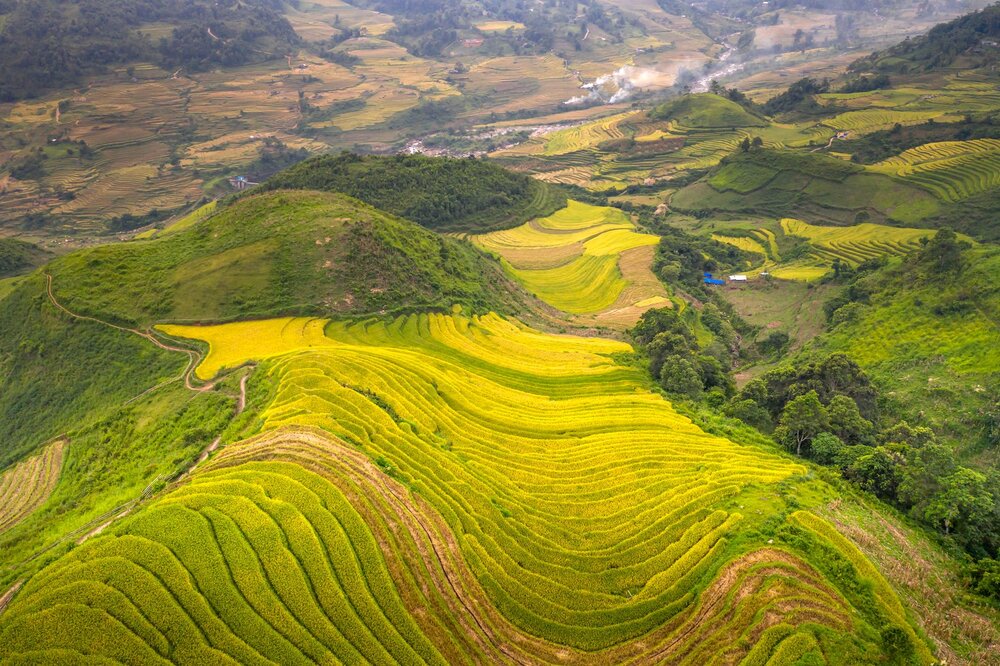
The most celebrated season — the rice ripens from green to gold between mid-September and mid-October, and the terraces in full harvest colour are among the most photographed landscapes in Vietnam. Mu Cang Chai and Sapa are at their absolute peak in late September to early October. The harvest season draws the largest crowds, particularly at Mu Cang Chai’s La Pan Tan and Che Cu Nha viewpoints, and at Sapa’s Muong Hoa Valley. Go early in the morning (6–8 AM) for the best light and the fewest visitors. The harvest window is only 2–3 weeks — the fields go from gold to stubble quickly once the cutting begins, so timing matters.
November–April: Fallow Season
After the harvest, the terraces are bare brown earth until the water-filling cycle begins again in May. This is the least visually dramatic period but not without appeal — the mountain air is clear and cool, the crowds are absent, and the terrace walls themselves (the engineering achievement) are most visible without the crops. For trekkers and hikers who want the trails without the peak-season crowds, November–April is the best window. Sapa in December–January is cold (sometimes below 10°C at night) — bring warm layers.
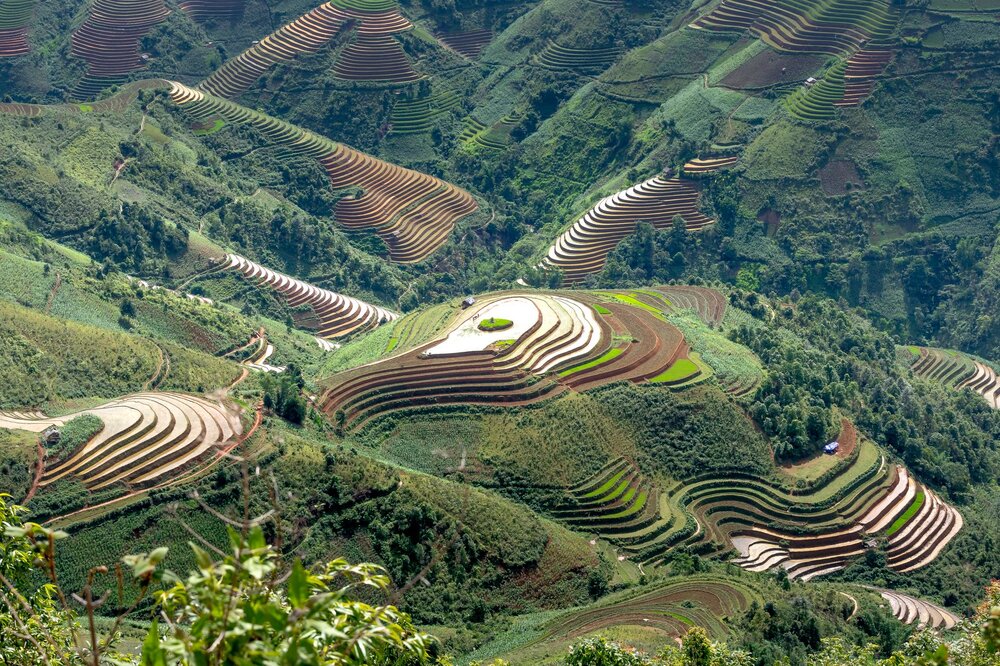
The Best Rice Terrace Destinations in Vietnam
Mu Cang Chai, Yen Bai Province
Mu Cang Chai is the benchmark — the most extensive, most dramatic, and most photographed rice terrace landscape in Vietnam. Located 300 km from Hanoi (7–8 hours by road) in Yen Bai Province, the district covers over 2,000 hectares of terraced fields built by the H’mong people over more than 20 generations. The La Pan Tan hillside — known locally as the “sticky-rice tray” for its circular stepped form — and the Che Cu Nha viewpoint are the two most iconic compositions. The approach road crosses the Khau Pha Pass (one of Vietnam’s four great mountain passes at 1,200 m), which has its own dramatic terrace views. September–October is the golden harvest peak; May–June has excellent water-reflection conditions with far fewer visitors.
Best for: Serious photography, the most spectacular single landscape, motorbike touring
Distance from Hanoi: 300 km / 7–8 hours by road
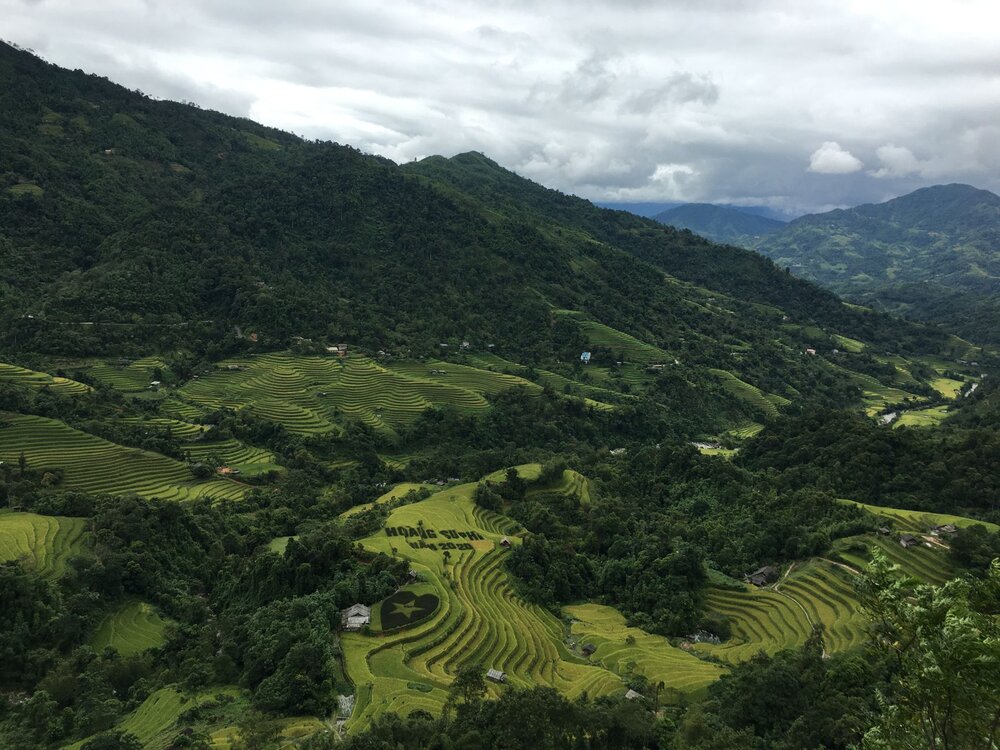
Hoang Su Phi, Ha Giang Province
Hoang Su Phi is the remote alternative to Mu Cang Chai — less famous, harder to reach, and genuinely less touristed. Located in Ha Giang Province near the Chinese border, the district has dramatic rolling hills and narrow valleys with terraces that display near-perfect symmetry across the slopes. Multiple ethnic minority communities (Dao, Nung, La Chi) have different planting schedules, so some terraces are at different phases at any given time — a patchwork of green, gold, and water-filled stages on the same hillside. The water-filling season (March–May) is Hoang Su Phi’s most spectacular phase. Access from Ha Giang City takes about 2 hours by motorbike or car.
Best for: Off-the-beaten-path experience, ethnic minority culture, March–May water season
Distance from Hanoi: 350 km to Ha Giang City + 2 hours onward
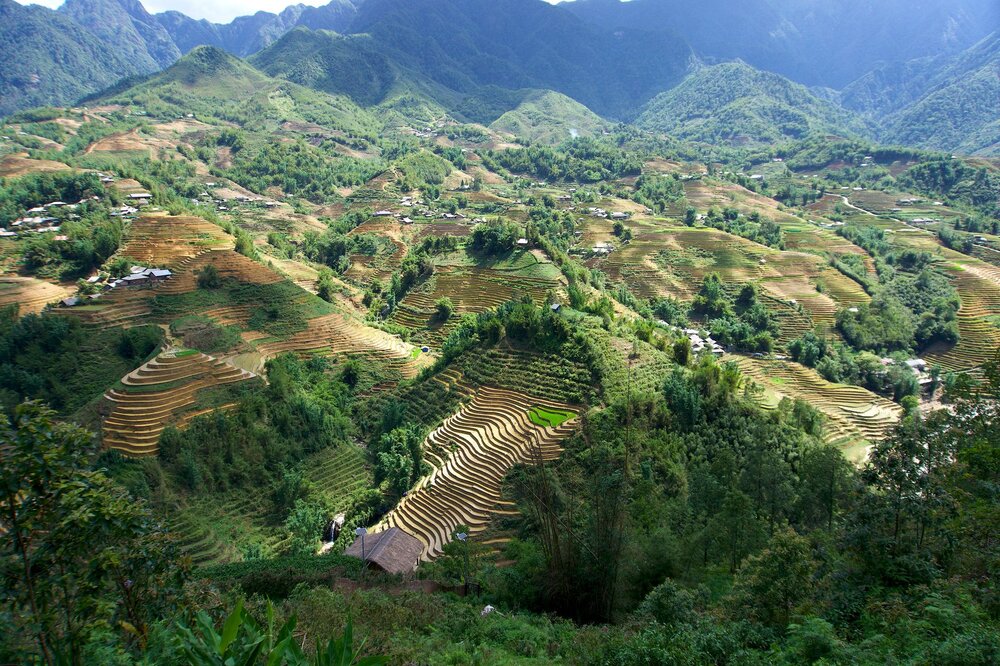
Sapa and the Muong Hoa Valley, Lao Cai Province
Sapa is the most accessible of the northern terrace destinations and the one with the best tourist infrastructure — hotels from luxury resorts to budget guesthouses, established trekking routes, and a well-developed homestay system in the surrounding ethnic minority villages. The Muong Hoa Valley below Sapa town is the main terrace landscape: a long valley with H’mong and Dao villages (Ta Van, Lao Chai, Ta Phin) connected by well-marked trekking trails through the terraced fields. Sapa is most beautiful in mid-August to early September for clear skies and green rice, and in September–October for the harvest. It is also the most crowded destination — Mu Cang Chai is the better choice for photography during peak harvest season.
Best for: First-time terrace visitors, trekking, homestays, accessibility
Distance from Hanoi: 350 km / overnight train + minibus, or 5.5 hours by bus
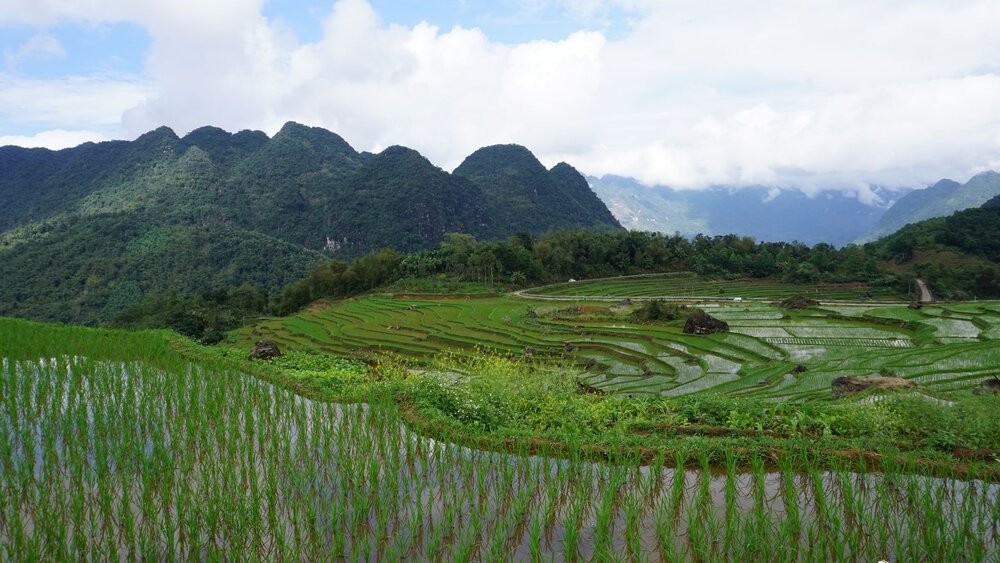
Pu Luong Nature Reserve, Thanh Hoa Province
Pu Luong is the closest major rice terrace destination to Hanoi (160 km / 4 hours) and the most relaxed in character — a protected nature reserve combining tropical forest, bamboo groves, waterfalls, and Thai and Muong ethnic minority villages in a valley of tiered rice fields. It lacks the sheer scale of Mu Cang Chai but compensates with accessibility, excellent boutique eco-lodges, and activities beyond the terraces (bamboo rafting, waterfall walks, village cycling). August to late October is the best period — the transition from lush green to gold. Pu Luong is ideal for families, couples, and anyone who wants the terrace experience without a long journey.
Best for: Short trips from Hanoi, families, eco-lodges, a relaxed pace
Distance from Hanoi: 160 km / 4 hours by road
Y Ty, Lao Cai Province
Y Ty is the least-known of the premier terrace destinations — a small Ha Nhi community perched at 2,000 m elevation in the northeastern corner of Lao Cai Province, 2 hours from Sapa. Known locally as a “cloud hunting” destination for the sea of clouds that fills the valley below the village on clear mornings, Y Ty combines cloud spectacle with rice terraces and the distinctive stone-roofed mushroom houses of the Ha Nhi people. The water-filling season (May) and the harvest (late September) are both excellent. The Saturday morning market draws multiple ethnic groups from surrounding villages — one of the most authentic hill tribe market experiences accessible from Sapa.
Best for: Cloud photography, ethnic minority culture, off-beat discovery
Distance from Sapa: 2 hours by motorbike or 4WD
Tips & Guide: How to Enjoy the Rice Terraces Well
Timing Your Visit Within the Season
The golden harvest window at Mu Cang Chai and Sapa is typically a 2–3 week period in late September to early October — the exact dates shift by 1–2 weeks depending on the year’s rain and temperature pattern. Check recent photos on Instagram (search the destination name in Vietnamese: Mù Cang Chải, Hoàng Su Phì) in the weeks before you travel to see the current stage. The water-filling season (May–June) has more flexibility — the reflections last several weeks — but the harvest window is tight. If you miss the golden peak, you miss it.
Get There Early
The best light for terrace photography is 6–8 AM (low angle, long shadows, dew on the fields) and 4–6 PM (warm late-afternoon gold). The famous viewpoints at Mu Cang Chai (La Pan Tan, Che Cu Nha) are crowded from 8 AM onward during the harvest season — arrive before 7 AM and you may have the viewpoints largely to yourself. Staying overnight in or near the terrace villages (rather than day-tripping from a town) is the most reliable way to secure the early morning window.
Go Off the Main Viewpoints
The famous viewpoint photos at Mu Cang Chai and Sapa represent a small fraction of the terrace landscape. A motorbike or bicycle gives access to the backroads between villages where the scenery is often just as good, the crowds are absent, and you are moving through the agricultural landscape rather than observing it from a fixed platform. The Vietnam Coracle’s documented motorbike routes through the northern terrace regions are the best free resource for self-guided backroad exploration.
Stay in a Homestay
A homestay in an ethnic minority village — available in all the major terrace destinations — is a qualitatively different experience from a hotel in the nearest town. You wake up inside the terrace landscape rather than driving to it; the family’s daily agricultural routine gives context to what you’re seeing in the fields; and the evening meals (home-cooked Thai, H’mong, or Muong food, often with local rice wine) are a significant part of the experience. In Pu Luong and Mai Chau, luxury eco-lodges built in the local architectural style offer a comfortable hybrid of homestay character and hotel service.
Respect the Fields and the Farmers
The terrace walls are fragile — a misplaced step can collapse a bund that takes hours to repair. Walk only on the established paths between fields; if there is no path, ask before crossing. Farmers are working when you visit — keep noise low around active harvesting groups, ask permission before photographing people (a smile and a gesture toward the camera is universal), and do not pick or damage the rice plants. The terraces are someone’s livelihood, not a film set.
Packing for the Terraces
- Footwear: Sturdy trekking shoes or trail runners with grip — the terrace paths are narrow earthen bunds that become very slippery when wet. Flip-flops are not appropriate for anything beyond the village paths.
- Rain gear: A quality waterproof jacket is essential in all seasons, particularly July–October. Mountain weather changes rapidly; afternoon showers are the norm in the wet season.
- Layers: Mountain elevations (Sapa at 1,600 m, Y Ty at 2,000 m) are significantly cooler than Hanoi — especially in the evenings and mornings from October onward. Bring a fleece or down layer even in September.
- Sun protection: At altitude, UV intensity is higher than at sea level — sunscreen (SPF 50), a wide-brim hat, and UV-blocking clothing are important for full-day outdoor walks.
- Cash: ATMs are rare or absent in Mu Cang Chai, Hoang Su Phi, and Y Ty. Withdraw sufficient cash (Vietnamese dong) in Hanoi or the nearest provincial town before heading into the terrace villages. Most homestays and guesthouses do not accept card payment.
- Insect repellent: Leeches are common on forest paths in the wet season (July–September), particularly in Pu Luong and the more forested areas. DEET-based repellent is the most effective deterrent.
- Portable power bank: Electricity is available but not always reliable in remote homestays — charge your devices at every opportunity and carry a power bank for longer field days.
Booking Tips
Book Accommodation Early for Peak Season
The golden harvest window at Mu Cang Chai (late September–early October) and Sapa is Vietnam’s most popular domestic tourism event — Vietnamese visitors book homestays and guesthouses months in advance for the harvest weekend. If you are targeting the peak golden period, book 2–3 months ahead. For the water-filling season (May–June), 3–4 weeks ahead is usually sufficient except on Vietnamese public holidays.
Hire a Local Guide for Remote Areas
A local guide is not essential at Sapa or Pu Luong (trails are well-marked), but is strongly recommended for the more remote destinations (Hoang Su Phi, Y Ty, Ha Giang) where the paths between villages are unmarked and the terrain is serious. In Sapa, licensed H’mong and Dao guides charge approximately 500,000 VND ($20) per group per day — book through your guesthouse or directly through the Sapa Tourism Information Center. A guide also provides cultural context that significantly enriches the experience beyond what the landscape alone offers.
Transport Planning
For Sapa: the overnight sleeper train from Hanoi (Tran Quy Cap Street station) to Lao Cai followed by a 1-hour minibus is the most comfortable option. For Mu Cang Chai: no direct public transport — the most practical option is a rented motorbike from Hanoi, a private car hire, or joining a tour. For Pu Luong: private car or motorbike from Hanoi (4 hours); budget bus services are available but add 2+ hours to the journey. For Hoang Su Phi and Y Ty: motorbike is the only practical self-drive option — the roads are mountain single-lane tracks unsuitable for most cars.
Choosing Between Destinations
- First terrace visit / limited time / need easy access: Pu Luong (from Hanoi, 4 hours, excellent eco-lodges, green or harvest season)
- Best single landscape for photography: Mu Cang Chai in late September (golden harvest, scale, La Pan Tan viewpoint)
- Trekking and village culture: Sapa (Muong Hoa Valley, established trail network, homestay circuit)
- Off the beaten path / authentic: Hoang Su Phi or Y Ty (remote, far fewer tourists, serious adventure)
- Water-filling season and cloud photography: Y Ty in May (cloud sea, mirror terraces, Ha Nhi market)
Tours & activities in Vietnam
Activity links above are affiliate or partner links.