
No transport method in Vietnam puts you closer to the country than a motorbike. The mountain passes of the north, the coastal switchbacks of the central route, and the river-delta backroads of the south are all landscapes that reveal themselves only at motorbike pace — the smell of pine forest at altitude, the heat rising off the road through Hai Van Pass, the sound of water buffaloes in a valley you’d never stop a bus to explore. Vietnam’s road network, the variety of its terrain across 1,650 km from north to south, and the culture of motorbike travel (Vietnamese ride everywhere) make it one of the finest motorbike destinations in the world. This guide covers what you need to know before you ride.
Do You Need a Licence to Ride in Vietnam?
Yes — and this is the most misunderstood rule for foreign riders in Vietnam. A Vietnamese driving licence is legally required for any motorcycle 50cc or larger. For foreign nationals, this means obtaining a temporary Vietnamese driving licence or holding a valid 1968 International Driving Permit (IDP) — the specific IDP issued under the 1968 Vienna Convention, which Vietnam acceded to in 2014.
Critical point: the IDP is not valid for citizens of Australia, Canada, Iceland, India, Ireland, Japan, New Zealand, or the USA, regardless of which IDP format they hold. Citizens of those countries must obtain a Vietnamese driving licence if they want to ride legally.
Riding without a valid licence carries a fine of approximately 2,000,000 VND (~$80 USD) — and more significantly, most travel insurance policies are voided if you have an accident while riding unlicensed. The fine is manageable; the medical bills from an uninsured accident in a remote mountain province are not.
For riders below 50cc (scooters and small automatics), no international licence is technically required — though local rules vary and insurance still applies. Most experienced riders use 110–150cc manual bikes for longer routes; the licence question is unavoidable at that engine size.
Which Bike to Choose
The right bike depends entirely on your route and experience level.
- Semi-automatic (Honda Wave, Yamaha Sirius, 110cc): The most common bike in Vietnam, cheap to buy (from $200–400 second-hand) and cheap to fix anywhere in the country. Excellent for flat coastal routes and city riding; underpowered for steep mountain passes with luggage. No clutch — ideal for riders without manual experience.
- Manual 110–125cc (Honda Win, Minsk copies): The classic “Easy Rider” bike. Slow, heavy, prone to breakdown — but parts are everywhere and any roadside mechanic can fix them. Beloved for their character; practical for the northern mountain loops.
- Trail/semi-trail 150–250cc (Honda XR150, Yamaha WR155, Royal Enfield Himalayan): The best choice for serious mountain routes (Ha Giang Loop, the northwest). More power for the passes, better suspension for rough roads, more reliable mechanically. More expensive ($800–2,000 second-hand) and harder to find a mechanic for in remote areas.
- Automatic scooter (Honda Air Blade, Yamaha NMax): Comfortable and fuel-efficient for city-to-city touring on flat roads. Not recommended for mountain passes — the automatic transmission and low ground clearance are limiting on steep, unpaved routes.
Buy or rent? For a north-to-south run (or vice versa), buying is usually cheaper than renting and you can sell at the other end. Hanoi (Dong Da district) and Ho Chi Minh City (Pham Ngu Lao area) have established second-hand motorbike markets for tourist sales. For a single-region loop (Ha Giang, Da Lat), renting from a local guesthouse or reputable dealer is more practical.
Best Motorbike Routes in Vietnam
The Ha Giang Loop
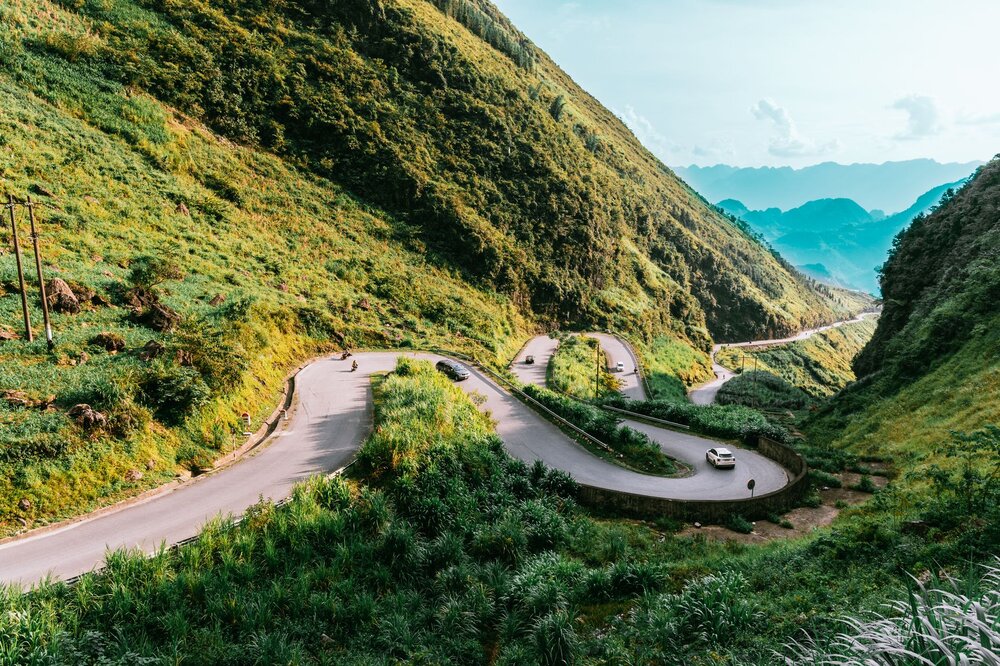
The Ha Giang Loop is Vietnam’s most celebrated motorbike route — a 350–400 km circuit through the Dong Van Karst Plateau Geopark in the far north, passing the Ma Pi Leng Pass (one of the most dramatic road sections in Southeast Asia), the Nho Que River canyon, the ancient Dong Van Old Quarter, and a series of H’mong and Lo Lo minority villages perched on limestone karst peaks. The loop is typically ridden over 3–4 days from Ha Giang City; most riders go anti-clockwise (Ha Giang → Quan Ba → Yen Minh → Dong Van → Meo Vac → Ha Giang) to ride the Ma Pi Leng Pass with the canyon on the outside edge. The roads are paved but steep, narrow, and winding — experience with mountain roads is strongly recommended. Ha Giang City is 320 km from Hanoi (6–7 hours); overnight bus or private car to Ha Giang, then rent locally.
The Ho Chi Minh Road (North)
The Ho Chi Minh Road — the wartime supply route that parallels the coast 50–200 km inland — is Vietnam’s great long-distance motorbike highway. The northern section (Hanoi to Hue or Da Nang, approximately 700 km) runs through the limestone karst scenery of Hoa Binh and Son La provinces, past Pu Luong Nature Reserve, through the Truong Son mountain range via a series of passes, and alongside the Phong Nha–Ke Bang National Park before emerging at the coast. Unlike Highway 1 (fast, flat, heavy with trucks), the Ho Chi Minh Road is quiet, scenic, and passes through small towns and villages that see almost no tourist traffic. Allow 5–7 days for the northern section; the road surface is excellent throughout.
The Da Lat Highlands Loop
The Da Lat Highlands Loop covers the Central Highlands of Vietnam — the cool plateau country between the coast and the Cambodian border — in a 400–600 km circuit from Da Lat. The route passes through coffee and tea plantation country (Da Lat to Bao Loc), the highland lakes and waterfalls near Da Lat itself, the ethnic minority villages of the K’Ho and Ma communities in the hills east of the city, and the dramatic road descent from the plateau to the coastal plain via the Ngoan Muc Pass. Da Lat’s altitude (1,500 m) keeps temperatures comfortable year-round; the highlands loop avoids the coastal heat entirely. Renting in Da Lat is straightforward and the city has several reliable rental operators.
The Pu Luong Loop
The Pu Luong Loop is the most accessible mountain motorbike route from Hanoi — a 300–350 km circuit covering Mai Chau, the Pu Luong Nature Reserve, the Muong villages of the Cham River valley, and the return via Hoa Binh. The route passes through rice terrace country, bamboo forest, traditional stilt-house villages, and the bamboo water wheels of the Pu Luong valley — all within 4–5 hours of Hanoi. The roads are paved (some sections unpaved in the nature reserve) and the route is suitable for intermediate riders on any bike. Allow 2–3 days; homestay accommodation in Thai and Muong villages is excellent throughout the route.
The Quy Nhon Coastal Road
The central coast section between Da Nang and Quy Nhon — via the Hai Van Pass, Hue, Hoi An, and the cliff-hugging road south of Quang Ngai — is Vietnam’s finest coastal motorbike riding. The Hai Van Pass (496 m, 21 km of switchbacks above the sea) is the signature feature; the views north over Da Nang Bay and south over Lang Co Lagoon from the summit are the most famous road views in the country. The full Da Nang to Quy Nhon section (280 km) takes 2 days at a comfortable pace; the road surface alternates between excellent highway and rougher coastal tracks through fishing villages. Morning departures avoid the midday coastal heat.
Best Time to Ride
Vietnam’s north-to-south length means no single month is ideal nationwide — the wet and dry seasons are staggered across the country’s regions.
- Northern routes (Ha Giang, northwest, Ho Chi Minh Road north): October–April is the dry season with clear roads; September–October adds the golden rice terrace harvest as a visual bonus. Avoid June–August when the mountain roads have frequent rain, fog, and occasional landslides.
- Central coastal route (Hai Van Pass, Da Nang to Hoi An, Quy Nhon): February–August is the dry season on the central coast; September–December brings the northeast monsoon with serious rain and occasional flooding — the Hai Van Pass in monsoon conditions is genuinely dangerous.
- Southern and Central Highlands (Da Lat, Mekong): November–April is the dry season; the highlands avoid the worst coastal heat year-round. Da Lat can be ridden comfortably in any season — the altitude keeps temperatures at 15–25°C.
- Full north-to-south run: November–March is the best overall window — the north is dry and cool, the central coast is transitioning out of monsoon, and the south is fully dry.
Safety Tips
- Helmet: A full-face helmet is essential — not the thin plastic bowls sold at roadside stalls. Bring one from home or buy a quality Thai/Vietnamese brand (Protec, Royal) in Hanoi or Ho Chi Minh City before departing. The helmet law is enforced; the cheap helmets offer almost no protection.
- Ride to the standard of Vietnamese traffic, not your home country’s: Vietnamese traffic flows differently — give way to larger vehicles, expect motorbikes to appear from any direction, and never assume right of way on a roundabout or intersection. Speed and aggression are counterproductive; patience and predictability are the core riding skills in Vietnam.
- Night riding: Avoid it, especially on mountain roads. Unlit vehicles, livestock on the road, and no road markings make night riding significantly more dangerous than day riding.
- Mountain roads: The biggest hazard on the Ha Giang Loop and northwest passes is not other traffic but the road itself — loose gravel on switchback corners, unexpected potholes, and sudden fog. Ride at a pace where you can stop within your line of sight.
- Roadside mechanics: Vietnam has an extraordinary density of roadside motorbike repair shops (xe may sua chua) — in most areas you will never be more than 10 km from one. A puncture repair costs 20,000–50,000 VND. Carry a basic toolkit and know how to check your oil, chain, and tyre pressure daily.
- Travel insurance: Confirm before you ride that your policy explicitly covers motorbike riding and that you hold the required licence. Many standard travel policies exclude motorised two-wheelers entirely; adventure-travel policies (World Nomads, True Traveller) typically include them with the licence condition.
Packing for a Vietnam Motorbike Trip
- Luggage: A dry bag or waterproof pannier bag (40–60L) strapped to the rear rack. Avoid backpacks for long rides — shoulder and back fatigue after 4+ hours on a bike is significant. Side panniers on a trail bike give better weight distribution.
- Riding gear: At minimum: full-face helmet, gloves (essential for grip and protection), and a windproof/waterproof jacket. Motorcycle boots or ankle-covering footwear for mountain roads. At altitude (Ha Giang, Da Lat in winter) a thermal base layer under your jacket is necessary — the wind chill at speed at 1,500 m in January is severe.
- Rain gear: A full waterproof poncho (the Vietnamese one-piece type that covers the bike handlebars) is essential from May–November. Mountain rain arrives fast and the temperature drop when wet at altitude is significant.
- Navigation: Maps.me (offline maps, excellent for Vietnam back roads) and Google Maps (for live traffic in cities). A phone mount on the handlebars is worth the $5 investment. The Ha Giang Loop has well-marked roads; the Ho Chi Minh Road requires more careful navigation between towns.
- Cash: ATMs are absent in many mountain areas. Carry sufficient dong for 2–3 days of fuel, food, and accommodation before reaching the next provincial town. Petrol stations are frequent on main roads; on the Ha Giang Loop carry a 2L emergency fuel bottle.
- Basic toolkit: Tyre levers, puncture repair kit, spare inner tube, adjustable spanner, chain lube, zip ties, and duct tape. On a semi-automatic Wave this covers 90% of roadside repairs; on a trail bike add a spark plug and brake pads.
- Documents: Passport, driving licence (IDP or Vietnamese), and bike registration papers (giay to xe) — carry originals, not photocopies. Police checks are common in the northwest and Ha Giang; having your documents immediately accessible saves time and avoids fines.
Costs
- Bike purchase: Semi-auto Honda Wave (second-hand, tourist sale) $200–400; trail bike 150cc $800–1,500
- Bike rental: Automatic scooter $5–8/day in cities; trail bike $15–25/day in Da Lat or Ha Giang
- Fuel: Petrol (xang) costs approximately 24,000–26,000 VND/litre; a 110cc Wave does 40–50 km/litre — a full tank ($1.50) covers 150+ km
- Accommodation: Guesthouses along major routes $6–15/night; homestays in ethnic minority villages $10–20/night including dinner and breakfast
- Roadside repairs: Puncture $1–2; oil change $3–5; chain replacement $8–15; most repairs are inexpensive if done at local mechanics rather than tourist-facing shops
Tours & activities in Vietnam
Activity links above are affiliate or partner links.