
Vietnam is one of the great motorbike countries. The roads through Ha Giang, the Ho Chi Minh Trail, the coastal run between Da Nang and Hoi An — riding these yourself is a different experience from any bus or tour. But the legal picture is more complicated than most travellers realise, and the consequences of getting it wrong go beyond a fine.
Here’s what you actually need to ride legally in Vietnam — and what to do if you can’t.
Can you legally ride in Vietnam?
To ride a motorbike over 50cc in Vietnam, you need one of the following:
- A valid Vietnamese motorcycle licence
- A valid domestic motorcycle licence paired with a 1968 Vienna Convention International Driving Permit (IDP) showing category A
- A valid motorcycle licence from an ASEAN member country
A few things that do not count:
- A car licence — it does not authorise you to ride a motorbike
- An IDP from the 1926 or 1949 conventions — Vietnam only recognises the 1968 version
- An IDP on its own — it must be carried alongside your original domestic licence
- The fact that a rental shop handed you a bike without asking — the shop’s willingness does not make it legal
Under 50cc — the small automatics sold as “scooters” — technically require no licence in Vietnam. But most rentable bikes for meaningful travel are 110cc and above, so this threshold rarely matters in practice.

The International Driving Permit explained
An IDP is not a standalone licence. It’s a translation document — it converts your existing domestic licence into a format recognised by other countries. You must carry both together.
Vietnam only accepts IDPs issued under the 1968 Vienna Convention. The earlier 1926 and 1949 versions are not valid here, even if they look official and were issued by a legitimate body in your country.
Your IDP must:
- Be issued under the 1968 Vienna Convention specifically
- Be issued by an officially authorised organisation (usually a national automobile association)
- Show motorcycle category A — if your domestic licence doesn’t cover motorcycles, the IDP can’t add that entitlement
- Be carried alongside your original domestic licence at all times
IDPs typically cost around USD $20–30 and are issued within a few days. Apply through your country’s official automobile association before you travel — not through any online third party.
Which countries can ride legally
This is where it gets complicated. Whether you can legally self-ride in Vietnam depends significantly on where you’re from.
ASEAN countries — full recognition
If you hold a valid motorcycle licence from an ASEAN member state, it’s recognised directly in Vietnam without needing an IDP. This covers Brunei, Cambodia, Indonesia, Laos, Malaysia, Myanmar, Philippines, Singapore, Thailand, and Timor-Leste.
Countries that can get a valid 1968 IDP
Most of Western Europe — including France, Germany, Italy, Spain, and the UK — can obtain a 1968 Vienna Convention IDP through their national automobile associations. If your domestic licence covers motorcycles and you get the right IDP, you can ride legally.
Countries that cannot get a valid 1968 IDP
This is the category that surprises most travellers. The United States, Australia, Canada, New Zealand, Japan, and South Korea issue IDPs under the 1949 convention — not the 1968 version Vietnam requires. That means citizens of these countries cannot legally self-ride a motorbike over 50cc in Vietnam on their home licence, regardless of their riding experience.
This isn’t a technicality that police ignore. It’s the legal position, and it has practical consequences for insurance.
Watch out for fake IDP websites
Search for “international driving permit” and you’ll find dozens of websites selling documents that look official but have no legal standing. They typically:
- Don’t name a specific government agency or authorised issuer
- Claim anyone can apply regardless of nationality or existing licence
- Offer instant downloads or very fast turnaround
- Use vague language about “acceptance” in multiple countries
- Charge anything from $15 to $100+
A fake IDP will not satisfy a Vietnamese police officer. It will not satisfy your travel insurer if you need to make a claim. And it won’t protect you legally if you’re involved in an accident. Only apply through your country’s official automobile association — the AA in the UK, AAA in the US (though as noted above, the US IDP won’t be valid in Vietnam regardless), NRMA/RACV/etc in Australia, and so on.
Documents to carry when riding
When riding in Vietnam you should have all of the following on you:
- Passport — or a certified copy; some riders carry a copy and keep the original at accommodation
- Visa documentation — e-visa approval or visa stamp
- Domestic motorcycle licence — original, not just a photo
- IDP — if applicable, must be the 1968 version
- Motorcycle registration papers — the blue book (cà vẹt) that comes with the bike
- Proof of insurance
If you’ve rented the bike, make sure the rental shop gives you the registration papers. Some shops hold them back — this is a problem if you’re stopped.
Road rules that matter
- Helmets are compulsory for rider and all passengers — both must wear them at all times. Fines for riding without a helmet are applied strictly, particularly at police checkpoints on popular tourist routes.
- Zero alcohol — Vietnam has a strict zero-tolerance policy for drink-riding. The enforcement has increased significantly in recent years.
- No motorways — motorbikes are not permitted on Vietnamese expressways. Stick to national highways (QL) and provincial roads.
- Speed limits — 40km/h in urban areas, 60km/h on rural roads for motorbikes. Limits are lower than for cars.
- Maximum one adult passenger plus one child — three adults on one bike is illegal and common cause for stops.
- Lights on from 6pm to 6am — and increasingly enforced during daylight hours too on national highways.
- Right-hand traffic — Vietnam drives on the right, the same as mainland Europe and the US.
Insurance — the part most people skip
This is the most overlooked part of riding legally in Vietnam, and potentially the most consequential.
Vietnam requires all motorbikes to carry compulsory third-party liability insurance (bảo hiểm xe máy). It’s cheap — around 60,000–100,000 VND per year — and should come with a registered bike. If you’re renting, check that the insurance is current and ask for the certificate.
Your travel insurance is a separate issue. Most policies cover motorbike riding in Vietnam only if:
- You hold a valid licence recognised in Vietnam
- The engine size is within the policy’s stated limit (often 125cc or 250cc — check the fine print)
- You were wearing a helmet at the time of any incident
If you’re riding without a legally recognised licence — for example, as a US or Australian citizen on your home licence without a valid IDP — your insurer has grounds to reject any claim. That includes medical costs if you’re injured, which can be substantial.
Read your policy before you ride. If it doesn’t explicitly cover motorcycle riding in Vietnam at your engine size, buy a policy that does.
Getting stopped by police
Police checkpoints are common on popular routes, particularly around Ha Giang, Sapa, and the central highlands. What to do:
- Pull over calmly and switch off the engine
- Have your documents ready — passport (or copy), licence, IDP, registration papers
- Be polite and patient. Most stops are routine and take a few minutes
- If you’re fined, ask for an official receipt (biên lai). Fines should be paid at a designated location, not handed over as cash on the spot
- If the bike is detained, note the officer’s name, badge number, and the station address
Common on-the-spot fines for tourists include riding without a helmet, carrying an invalid licence, and speed violations. Fines vary but are typically in the 400,000–1,000,000 VND range for licence issues.
If you don’t have valid documentation, there’s limited recourse. The bike can be impounded until fines are paid, which creates a significant logistical problem mid-trip.
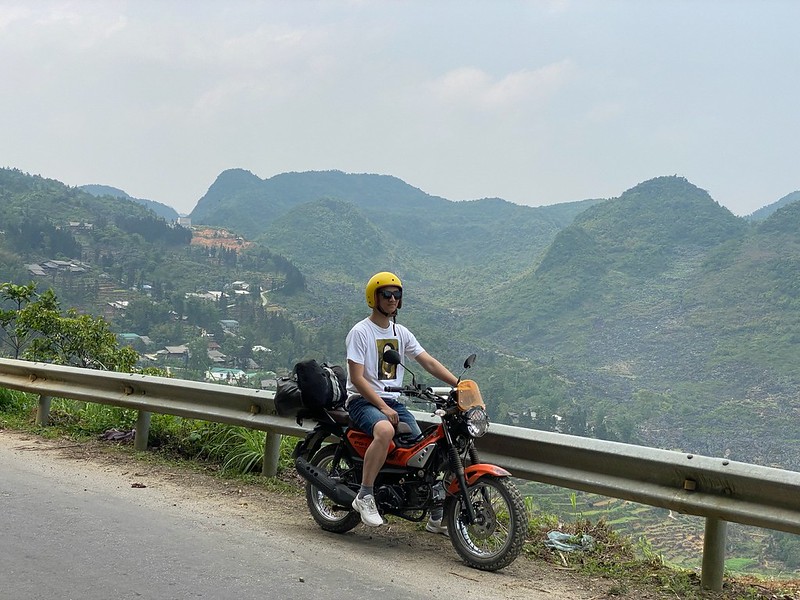
Alternatives if you can’t ride legally
If your nationality means you can’t get a valid 1968 IDP — or you simply don’t want to deal with the paperwork — there are good alternatives:
- Easy Rider tours — ride as a passenger behind a licensed local guide. This is how most travellers experience the central highlands and Ho Chi Minh Trail. The guides know the roads intimately and the experience is genuinely excellent.
- Guided motorbike tours — group tours with licensed guides, particularly on the Ha Giang Loop and in Sapa. You get the mountain roads without the legal exposure.
- Semi-self-guided tours — some operators provide a local guide who rides with the group but you ride your own bike. Check whether your licence situation is covered by their insurance arrangement.
- Under-50cc scooters — technically no licence required, though they’re not suitable for mountain roads or longer distances.
→ See our full Vietnam motorbike guide for routes, tips and what to pack
Tours & activities in Vietnam
Activity links above are affiliate or partner links.