
South of Ho Chi Minh City, the Mekong Delta is a vast, waterlogged patchwork of rice paddies, fruit orchards, and canals fed by the Mekong River’s final stretch before it meets the sea. The river splits into nine branches here, the “Nine Dragon River,” feeding a network of waterways that — until July 2025 — spread across thirteen provinces, now consolidated into six. Life runs on the water — houses on stilts, floating markets, and boats used the way roads are used elsewhere — and the delta rewards those who venture beyond a single day trip from Saigon.
Since 1 July 2025, the Mekong Delta has been reorganised from 13 provinces into 6 administrative units. The places below are unchanged — only some provincial names have shifted. Key changes for travellers: Phu Quoc is now in An Giang Province (previously Kiên Giang); My Tho is now in Dong Thap Province (previously Tiền Giang); Ben Tre City is now in Vinh Long Province; Soc Trang City is now part of Can Tho City; Bac Lieu City is now in Ca Mau Province.
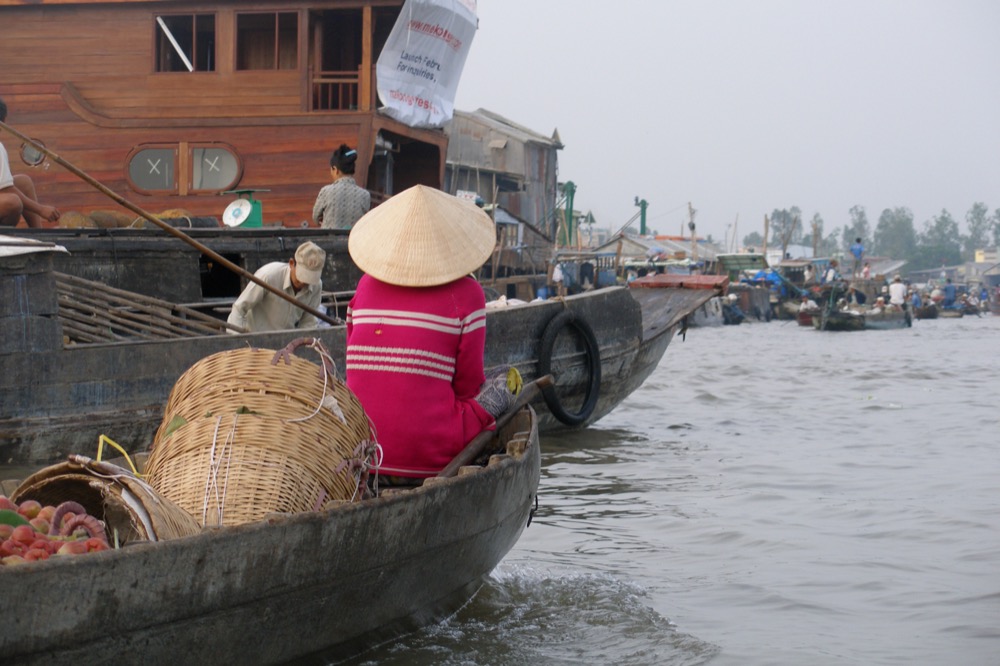
Cai Rang Floating Market & Can Tho
Can Tho, the delta’s largest city, is built around Ninh Kieu Wharf, the riverside promenade and boat harbour that most tours depart from. Just outside the city, Cai Rang Floating Market is the delta’s biggest and best known, wholesale boats hanging a sample of their cargo — watermelons, pineapples, cabbages — from tall poles so buyers can spot what they need from a distance. Nearby, Binh Thuy Ancient House, a 19th-century merchant villa mixing French colonial and Vietnamese design, was a filming location for The Lover.
Chau Doc & the Cambodian Border
An Giang province’s Chau Doc sits near the Cambodian border, its Chau Doc Floating Village a community of houseboats and fish cages moored along the Hau River. Ba Chua Xu Temple, at the foot of Sam Mountain, is one of southern Vietnam’s most important pilgrimage sites, busiest during its spring festival. A short drive away, Tra Su Cajuput Forest floods each year into a maze of algae-green canals, explored by small boat beneath a flooded forest canopy alive with roosting storks.
Wetlands & Birdlife
Dong Thap province’s Tram Chim National Park protects one of the last strongholds of the rare Sarus Crane within the wider Dong Thap Muoi (Plain of Reeds) wetland, a vast seasonal marsh that floods each year with the Mekong’s rise. Closer to Can Tho, Bang Lang Stork Sanctuary is a private garden turned major roosting site, most dramatic at dusk as thousands of birds stream in to nest. Bac Lieu Bird Sanctuary, on the coast, adds mangrove-fringed breeding colonies of herons and egrets.
Sa Dec & the River Towns
Sa Dec, in Dong Thap, is one of the delta’s main flower-growing centres, its riverside plots of marigolds and chrysanthemums at their fullest before Tet. The town’s Huynh Thuy Le Ancient House, an early 20th-century French-Vietnamese merchant home, is tied to Marguerite Duras’s novel The Lover. In Vinh Long, river islands thick with fruit orchards have become the delta’s main homestay destination, with Tra On Floating Market offering a quieter, more local alternative to Cai Rang.
Khmer Heritage & the Coast
Soc Trang (now administratively part of Can Tho City) and Tra Vinh have some of the delta’s largest ethnic Khmer populations, visible in distinctive pagoda architecture found nowhere else in the region. Soc Trang’s Bat Pagoda is known for the colony of giant fruit bats roosting in its garden trees by day. Tra Vinh’s Ang Pagoda and the tree-root-ringed Ba Om Pond reflect the same Khmer heritage. On the coast, Bac Lieu’s offshore wind farm — Bac Lieu City is now part of Ca Mau Province — rises directly from tidal mudflats, a striking modern contrast to the surrounding rice country.
Food & Local Cuisine
The delta’s cuisine leans on what the water and land provide: hu tieu, a clear-broth noodle soup particular to the south, bun ca (fish noodle soup), and lau mam, a pungent fermented fish hotpot eaten with a plate of fresh herbs. Ben Tre (now part of Vinh Long Province), known across Vietnam as the “coconut kingdom,” produces much of the delta’s coconut candy by hand in small riverside workshops, alongside rope and handicrafts made from the fruit. Fresh fruit — durian, longan, rambutan, dragon fruit — is sold straight from boats and roadside stalls throughout the region.
Boat Tours & Village Visits
Beyond the floating markets, boat tours weave through narrower canals to visit village workshops producing rice paper, coconut candy, or puffed rice, and Ben Tre’s coconut groves are best explored by a mix of rowboat and bicycle along shaded canal paths. Some itineraries add a homestay in Vinh Long, letting visitors experience canal-side life overnight with a local family rather than as a rushed day trip from the city.
How big is the Mekong Delta, really?
Here’s something most first-time visitors get wrong: the Mekong Delta is not a single destination you can tick off in a day trip from Ho Chi Minh City.
The delta covers around 40,000 km² — roughly 12% of Vietnam’s total land area, or about the size of Switzerland. A day trip to My Tho or Ben Tre puts you on the northern fringe of it. The region stretches all the way south to Ca Mau, the country’s southernmost tip, west to Phu Quoc island, and takes in an enormous mix of terrain in between: rivers and canals, floating markets, fruit orchards, mangrove forests, national parks, and coast-facing fishing towns. Driving from one end to the other takes seven to nine hours depending on your route.
One day gives you a taste. Three to five days gives you the real thing — enough time to reach Can Tho’s floating markets, push further into Dong Thap’s bird sanctuaries or Soc Trang’s Khmer temples, and still have a night in a canal homestay without feeling like you’re rushing the whole time. Each part of the delta has its own personality, and the further you get from the standard tour circuit, the more interesting it gets.
Best Time to Visit
Planning a trip to Mekong Delta? We arrange private guided tours — day trips, multi-day itineraries, and custom routes.
The delta has a tropical climate with a dry season from November to April, generally considered the best time to visit for sunny weather and easier road access to smaller towns. The rainy season, May to October, brings its heaviest rainfall from June to August, though afternoon showers rarely disrupt travel for long. The flood season, roughly August to November, is worth targeting for Tra Su and Dong Thap Muoi’s wetlands, and dry season (December to May) for the best chance of seeing Sarus Cranes at Tram Chim.
Getting There
Most visitors reach the Mekong Delta overland from Ho Chi Minh City, with buses from Mien Tay or Mien Dong bus stations taking 2-3 hours and costing roughly 100,000-200,000 VND. Day tours and multi-day trips are widely available from HCMC, typically combining a bus or van transfer with boat legs on arrival. Can Tho, Phu Quoc (now in An Giang Province), Rach Gia, and Ca Mau all have small airports with domestic connections for those short on time.
Where to Stay
Can Tho is the delta’s largest hub and offers the widest range of hotels, making it a practical base for visiting Cai Rang market and surrounding canals. Vinh Long and Chau Doc have simpler guesthouse options and are popular for river homestays, where visitors overnight with local families directly on the water. Many travellers still do the delta as a single overnight or day trip from Saigon rather than basing here for multiple nights.
Practical Tips
Book a floating market boat trip the evening before to catch Cai Rang at its 6am peak, since it thins out fast after 8am. Bring cash, as small towns and boat vendors rarely take cards. Sun protection matters more than it seems — hours on an open boat add up quickly. Mosquito repellent is worth packing for canal-side stops and wetland visits, especially in the flood season.