
Two weeks is the right amount of time to travel the length of Vietnam and actually feel like you’ve seen it. You can go from Hanoi in the north to Ho Chi Minh City in the south, stopping at Ha Long Bay, Ninh Binh, Phong Nha, Hue, Hoi An, and Nha Trang along the way — without rushing any of it.
Shorter than that, and you’re better off picking a region and going deep rather than trying to cover the whole country at pace. With two weeks, you can do both: cover the ground and still have time to sit in a café, get lost in a market, and eat properly.
How long should you spend in Vietnam?
Two weeks is the sweet spot for a first trip. It gives you enough time to cover the main stops without spending every day on a bus or at an airport. If you only have ten days, focus on either the north (Hanoi, Ha Long Bay, Ninh Binh, Sapa) or the south (Ho Chi Minh City, Hoi An, Hue, Da Nang) and skip the middle. A month gets you into the quieter corners — Con Dao, the Mekong Delta, Ha Giang, the northwest highlands.
Where should you go with two weeks in Vietnam?
The classic route runs Hanoi → Ha Long Bay → Ninh Binh → Phong Nha → Hue → Hoi An → Nha Trang → Ho Chi Minh City. That’s eight stops in fourteen days, which sounds like a lot but the distances are manageable and the overnight train between several legs means you don’t lose a full day to travel.
Each stop earns its place. Ha Long Bay is one of the most striking landscapes in Asia. Phong Nha has the world’s largest cave system. Hoi An is a UNESCO-listed old town that actually deserves the designation. None of these are places you’ll regret including.
How much will you spend in two weeks in Vietnam?
Budget travellers staying in hostels, eating street food, and taking public buses and trains can do two weeks for around USD 700–900 including flights. Mid-range travellers — decent hotels, some private transport, a Ha Long Bay cruise — are looking at USD 1,500–2,500. At the luxury end, with premium cruises, boutique hotels, and private transfers, budget USD 4,000 or more.
Food is very cheap across the board. A bowl of pho costs around 40,000–60,000 VND (USD 1.50–2.50) at a local place. A sit-down meal at a mid-range restaurant with drinks rarely exceeds 200,000–300,000 VND per person. The big costs are accommodation, Ha Long Bay (a decent cruise costs USD 120–200 per person), and domestic flights if you choose to fly rather than take the train.
Should you travel north or south in Vietnam?
Travel north to south. Most tourists go the other way — arriving in Ho Chi Minh City and heading north — which means bus and train tickets are easier to get heading southbound, and you’ll often be going against the flow of tour groups. It also means if you’re continuing into Southeast Asia after Vietnam, you have more options: overland into Cambodia from HCMC is straightforward, and from there into Thailand.
For international flights, HCMC tends to have more routes and cheaper fares than Hanoi. One option: fly into HCMC, take a cheap domestic flight up to Hanoi on arrival day, and then travel south at your own pace back to HCMC for your departure.
Day 1
Hanoi
Don’t try to see everything on the first day. Arrive, orient yourself, and pick a few things rather than rushing through a checklist.
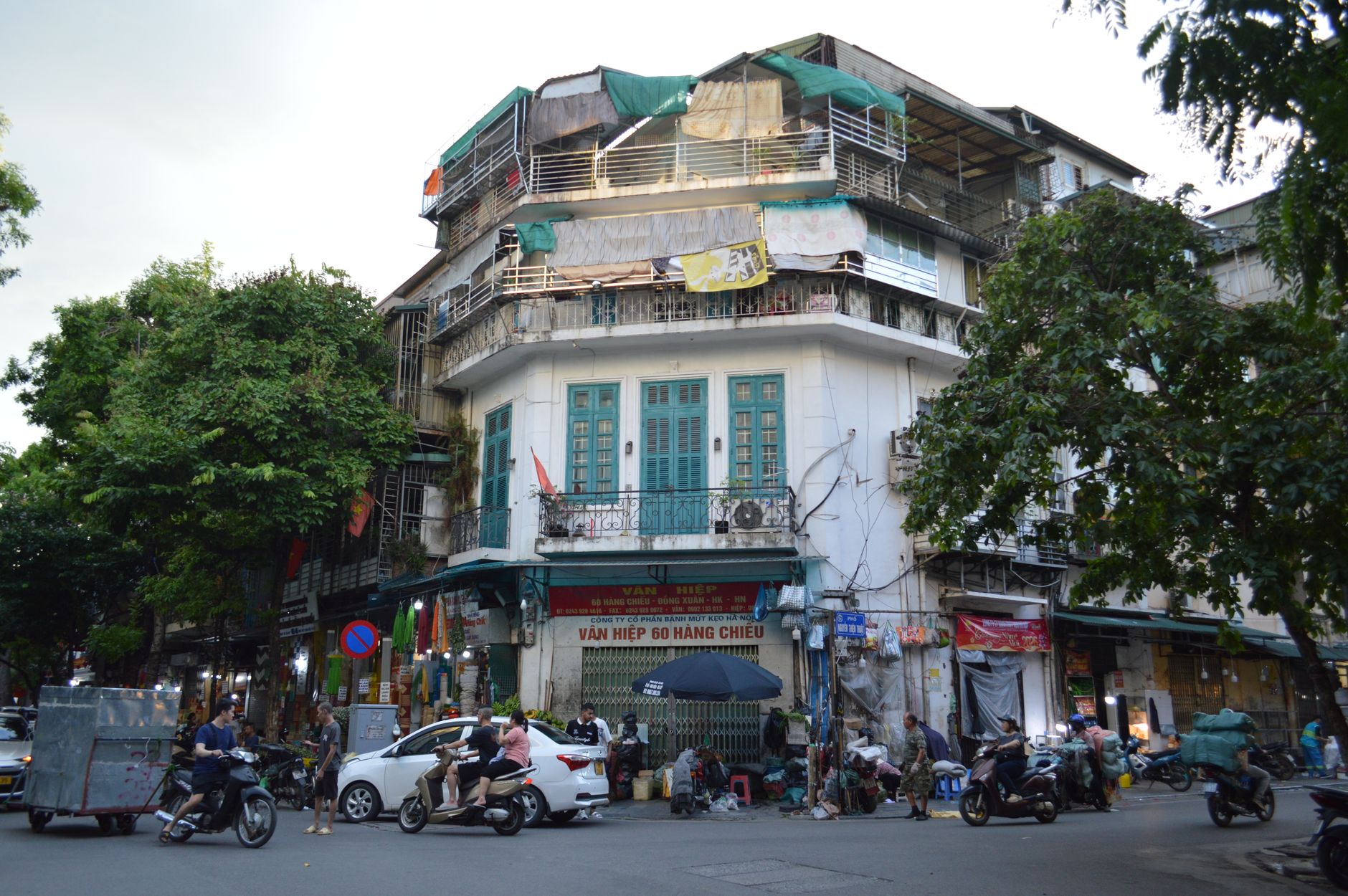
Start with the Ho Chi Minh Mausoleum — queues form early and move slowly, so arriving before 8am gets you through faster. From there, walk to the Old Quarter: 36 streets, each historically dedicated to a specific trade, now a dense mix of shophouses, street food stalls, and small temples. The area around Hoan Kiem Lake is where most visitors end up — the lake is pleasant, the Ngoc Son Temple on the small island is worth the bridge crossing.
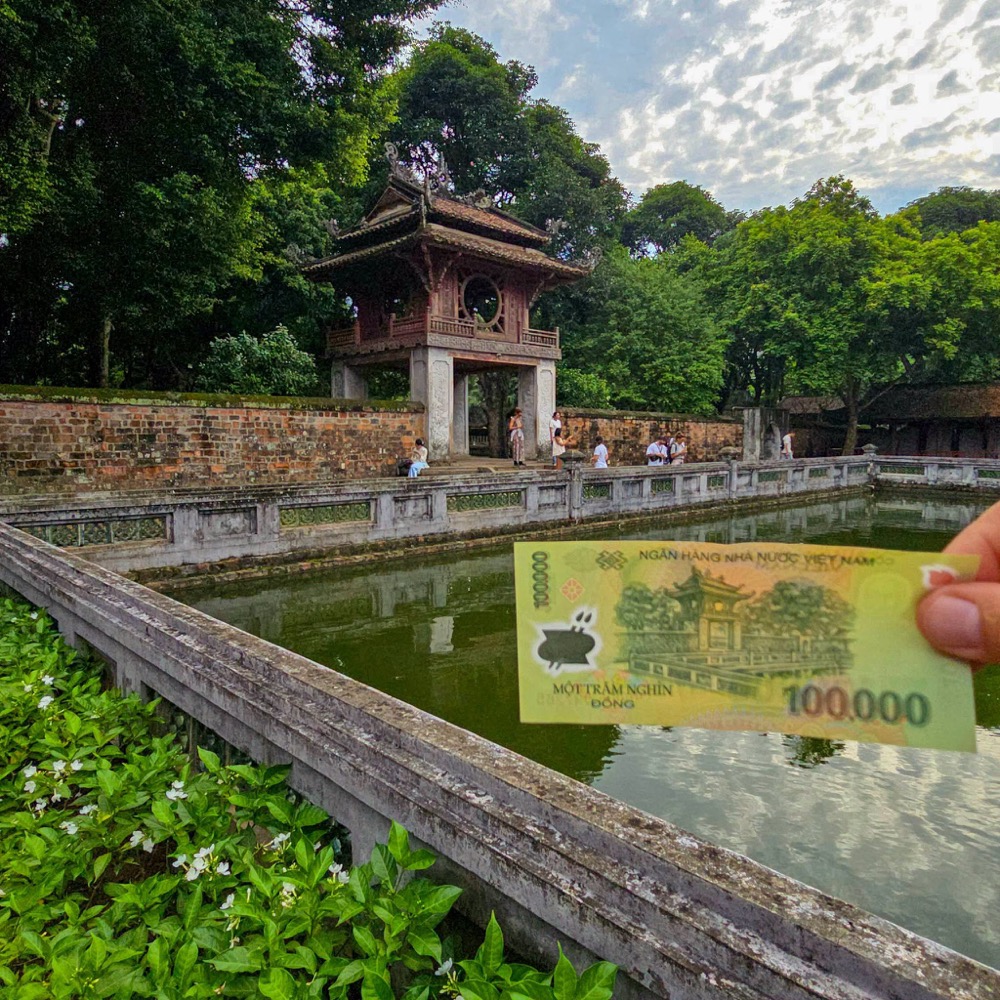
If you have afternoon energy left: the Temple of Literature (Van Mieu) is the best-preserved example of traditional Vietnamese architecture in the city, and the Vietnam Museum of Ethnology is the most informative museum in the country on the cultures of Vietnam’s 54 ethnic groups. Either one is worth two hours.
In the evening, go to Bia Hoi Corner — the junction of Ta Hien, Luong Ngoc Quyen, and Dinh Liet streets in the Old Quarter. Plastic stools on the footpath, fresh draught beer at around 5,000 VND a glass, and the sort of chaotic, cheerful street atmosphere that’s hard to find anywhere else. Order some food from the stalls nearby and stay for a while.

Day 2
Hanoi rewards a second day. The city has a slower pace than Ho Chi Minh City and is better appreciated by wandering than by ticking boxes.
Options for the day: Hoa Lo Prison (the “Hanoi Hilton”, used for American POWs during the war), the Imperial Citadel of Thang Long, the Vietnam Fine Arts Museum, or the Vietnam Military History Museum. Any one of these is worth two to three hours. Don’t try to do all four.
Alternatively, do a food tour. Hanoi’s street food scene — bun cha, bun bo, banh mi, egg coffee, cha ca — is distinct from the south and worth exploring properly before you move on. A guided tour in the early evening hits multiple neighbourhoods and explains the dishes as you go, which is more useful than eating alone and guessing what you’ve ordered.
A less obvious option: the railway line that runs through the Old Quarter’s residential streets. The train passes close enough to the houses that residents have to bring their chairs inside. Hanoi Train Street is a genuine neighbourhood rather than a tourist attraction, and the daily train still runs.
Optional: Sapa
If you have an extra two or three days, Sapa is the main reason to add time to the northern leg. The overnight train from Hanoi to Lao Cai takes about eight hours, and from Lao Cai a bus or minivan gets you up to Sapa town. The trekking here — rice terrace landscapes, Hmong and Dao villages, mountain ridgelines — is some of the best in Vietnam. Go with a local guide rather than a large tour group; the experience is completely different. After Sapa, return to Hanoi and continue with the itinerary below.
Day 3
Ha Long Bay
Ha Long Bay is crowded and heavily touristed, and you should go anyway. The 1,600 limestone islands rising from the green water of the Gulf of Tonkin are one of those landscapes that doesn’t look real from the boat deck — vertical karst formations draped in jungle, narrow passages between cliff walls, floating fishing villages. UNESCO listed it for a reason.

The standard way to visit is a one-night or two-night cruise on a junk boat, departing from Hanoi in the morning and returning the following afternoon. Most tours include meals, kayaking, and a cave visit. Book in advance with a reputable operator — the range of quality is very wide. Buying the cheapest deal from a Hanoi travel agent sometimes works out fine and sometimes doesn’t. Mid-range cruises (USD 120–200 per person per night) are more reliable.
If you want more space and fewer boats, consider Lan Ha Bay (adjacent to Cat Ba Island) or Bai Tu Long Bay (northeast of Ha Long). Both offer similar landscapes with significantly less traffic.
Day 4
The second day on the cruise typically includes an early morning activity — Tai Chi on the deck, a sunrise swim, a visit to a floating village — before heading back toward the harbour. Most tours return to Hanoi by late afternoon.
At this point you have a choice: spend the night in Hanoi or take the evening train directly to Ninh Binh. If you’re tired, stay in Hanoi. If you’re in good shape, the 19:30 train from Hanoi reaches Ninh Binh at 21:32 and puts you a day ahead.
Day 5
Ninh Binh
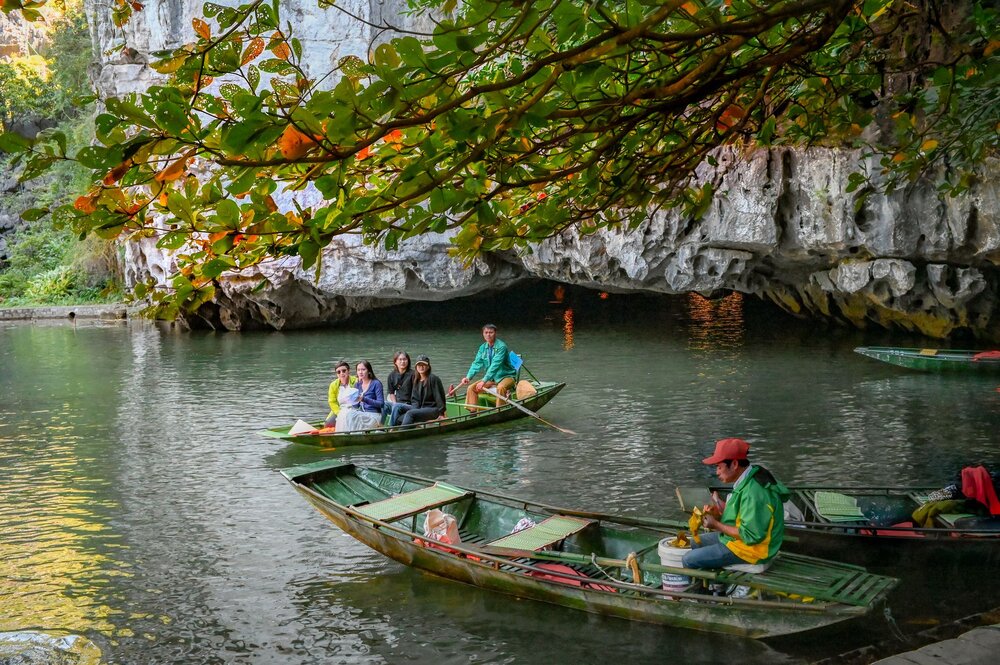
Ninh Binh is about 100 km south of Hanoi — an hour on the train — and the landscape is Ha Long Bay without the sea. Karst limestone peaks rise from rice paddies and river channels, and the boat trips here go through caves and past cliff faces rather than between ocean islands. It’s quieter than Ha Long Bay and, for some people, more affecting.
The main choice is between Trang An and Tam Coc. Both offer boat rides through the karst scenery; Trang An has a longer route and passes through more caves. Hire a bicycle from your accommodation and cycle out — the road between the two areas passes through flat rice-field countryside that’s worth seeing at its own pace.
Hoa Lu, 3 km north of Ninh Binh town, was Vietnam’s capital in the 10th century. Two temple complexes remain — dedicated to the Dinh and Le dynasties — set against limestone cliffs. Worth an hour if you’re interested in pre-Hanoi Vietnamese history.
The local speciality is thit de — goat cooked multiple ways, usually served with rice paper and fresh herbs. Most restaurants near Tam Coc serve it.
Day 6
Phong Nha Ke Bang
Today is mostly a travel day. The train from Ninh Binh to Dong Hoi (the nearest city to Phong Nha) leaves at 08:27 and takes about five hours; from Dong Hoi, a local bus or taxi covers the 45 km to Phong Nha town. If you’re travelling overnight, there are trains leaving Ninh Binh at 21:45 and 22:55 that arrive in the early morning.
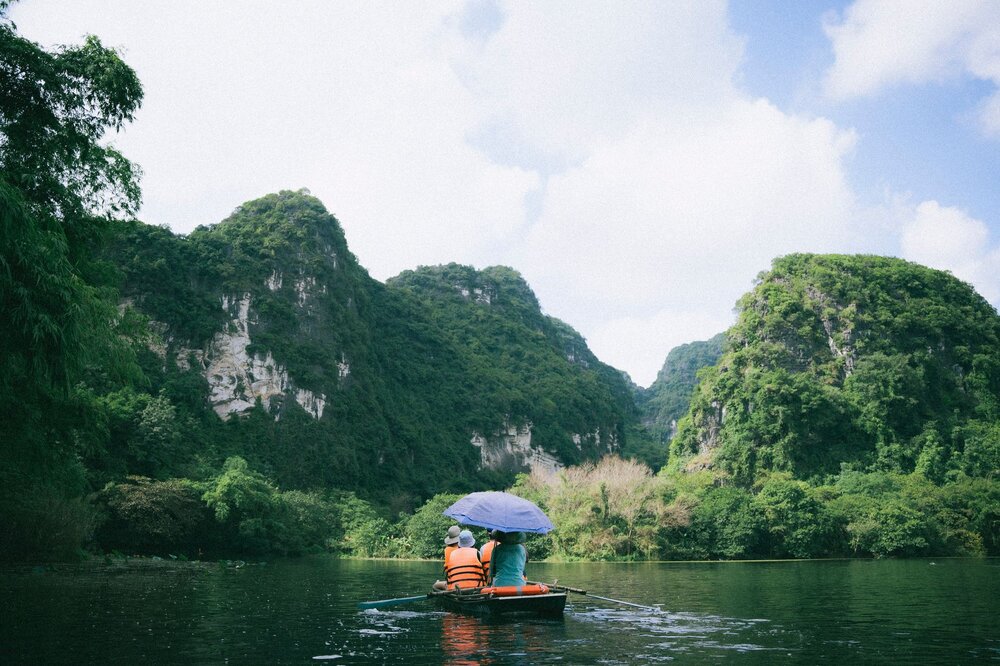
Once you’re in Phong Nha, settle in and hire a bicycle. The countryside here — flat river valley, limestone karst ridges on either side, small farming villages — is one of the most pleasant cycling environments in central Vietnam. The Phong Nha-Ke Bang National Park has over 300 caves, and the area around town gives you a good sense of the landscape before you go underground the next day.
Day 7
The caves. This is why you came to Phong Nha.
Son Doong — the world’s largest cave, large enough to contain a 40-storey building — requires a permit, costs around USD 3,000 per person, and books out months in advance. If that’s on your list, plan well ahead. But Phong Nha Cave, Paradise Cave, Dark Cave, and Tu Lan are all accessible on standard tours and are genuinely extraordinary.
Paradise Cave is the highlight for most visitors: a 31-km cave system with an entrance chamber the size of a cathedral, its floor covered in stalagmites that have grown for millions of years. The standard tour covers the first kilometre, which is enough. If you want to go deeper — literally — the extended tour takes you 7 km in with headlamps and guide ropes.
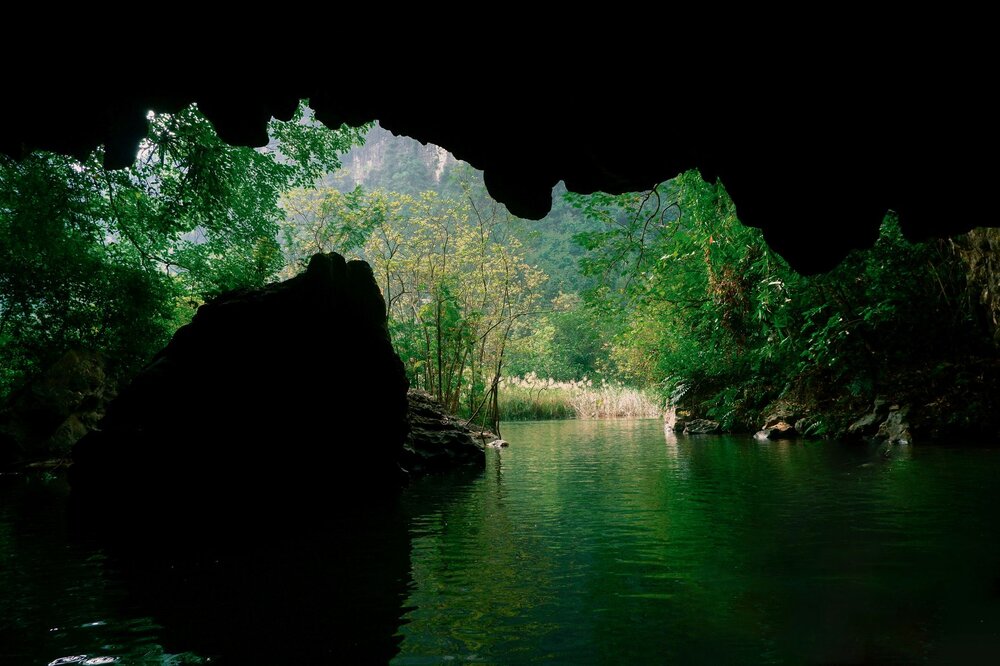
Dark Cave pairs a cave visit with a zip-line entrance over the river, kayaking through a subterranean lake, and a mud pool. It’s more of an adventure activity than a heritage visit, and it’s very good.
Tour operators and hotels in town offer combinations of these. Book the night before and go early — the caves get busier by midday.
Day 8
Hue
The journey from Phong Nha to Hue requires getting from town to Dong Hoi first — early bus at 05:30, local taxi, or a motorbike arranged through your accommodation — and then the train south. The 07:45 from Dong Hoi arrives in Hue at 10:47, which is a reasonable start to the day.
Hue was the imperial capital of unified Vietnam from 1802 to 1945 under the Nguyen dynasty, and the city still carries the weight of that history. The Imperial City — a walled citadel within a citadel, modelled on Beijing’s Forbidden City — is the main site. The outer walls take 20 minutes to walk; the inner compound contains throne halls, royal gardens, libraries, and temples, many damaged in the 1968 Tet Offensive and still under restoration. Allow three to four hours.
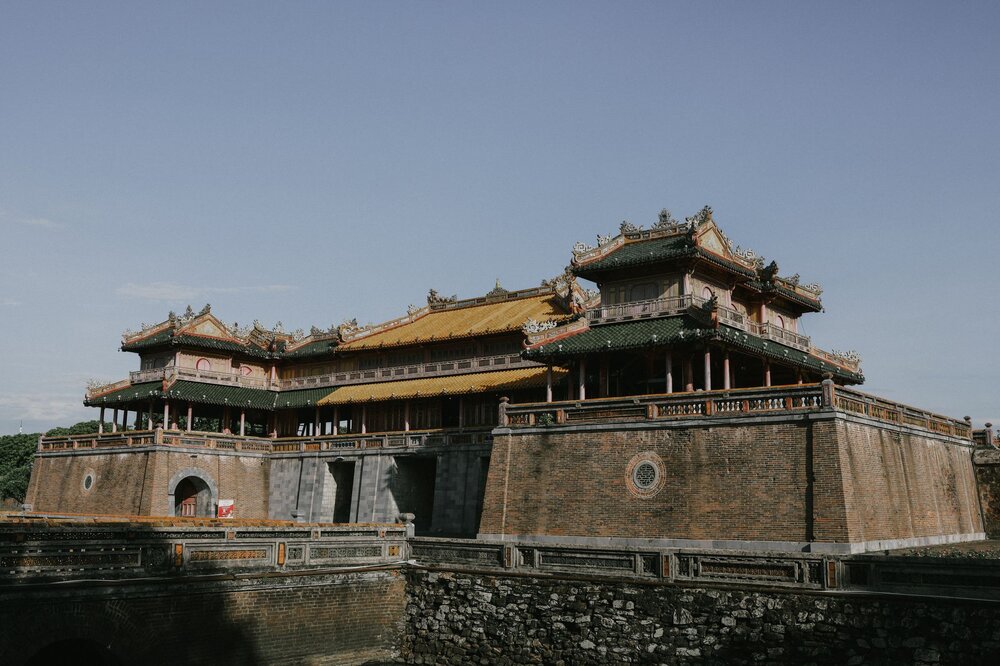
If you arrive by midday, you’ll have time to also see Thien Mu Pagoda on the Perfume River (the seven-storey tower is one of the most recognisable structures in Vietnam) and one of the royal tombs outside the city — Khai Dinh’s is the most visually striking, with its mosaic-covered interior; Tu Duc’s is the most atmospheric, set among pine trees beside a lake.
Stay the night. After an early start, a hotel to leave your bags in and an afternoon rest is worth more than pushing straight through to Hoi An.
Day 9
Hoi An
The morning train from Hue to Da Nang leaves at 08:45 and takes about 2.5 hours along one of the most scenic rail routes in Vietnam — the Hai Van Pass section has the track running along cliff edges above the sea. From Da Nang, the yellow city bus (Route 1, around 20,000 VND) or a Grab connects to Hoi An in 45 minutes.
Hoi An was a major trading port from the 15th to the 19th century — Japanese, Chinese, Dutch, and Portuguese merchants all had quarters here — and the architecture from that period has been preserved well enough to make the old town feel genuinely different from anything else in Vietnam. It is crowded, and increasingly commercial, but the streets and buildings are the real thing.
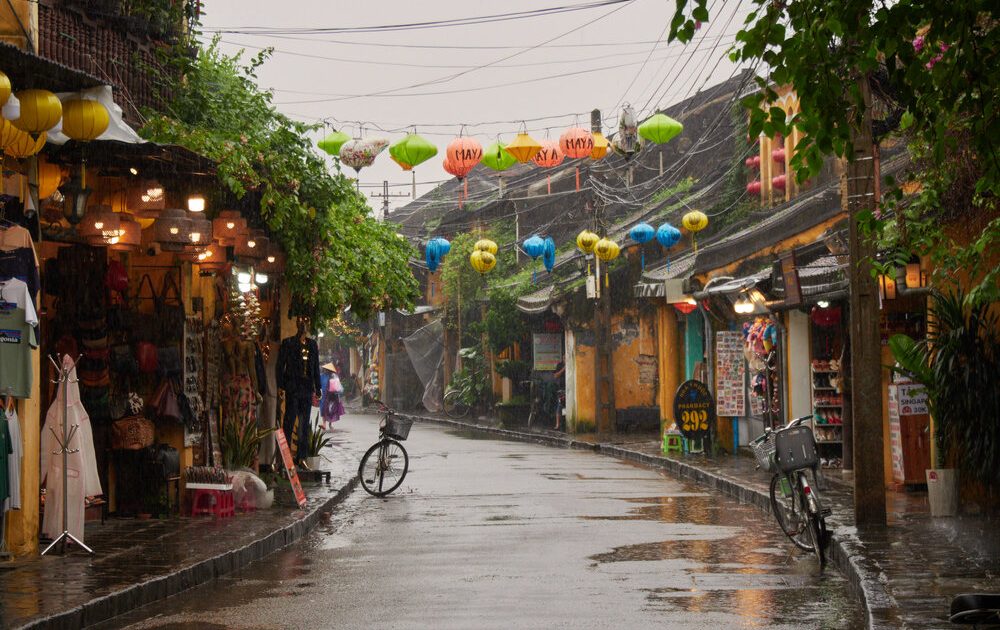
Spend the afternoon walking. Cross the lantern-lit streets of the old quarter, look into the merchant houses (several are open on entry tickets included in the town pass), walk the Japanese Covered Bridge, cross to the islands south of the main town via the small footbridges — the southern islands are quieter and the walking is pleasant.
In the evening the town transforms. Lanterns are lit, the night market opens on An Hoi Island, and the river fills with floating lanterns released by tourists and locals. If you haven’t eaten cao lau yet — thick rice noodles with pork, char, and local herbs, a dish specific to Hoi An — tonight is the night.
Day 10
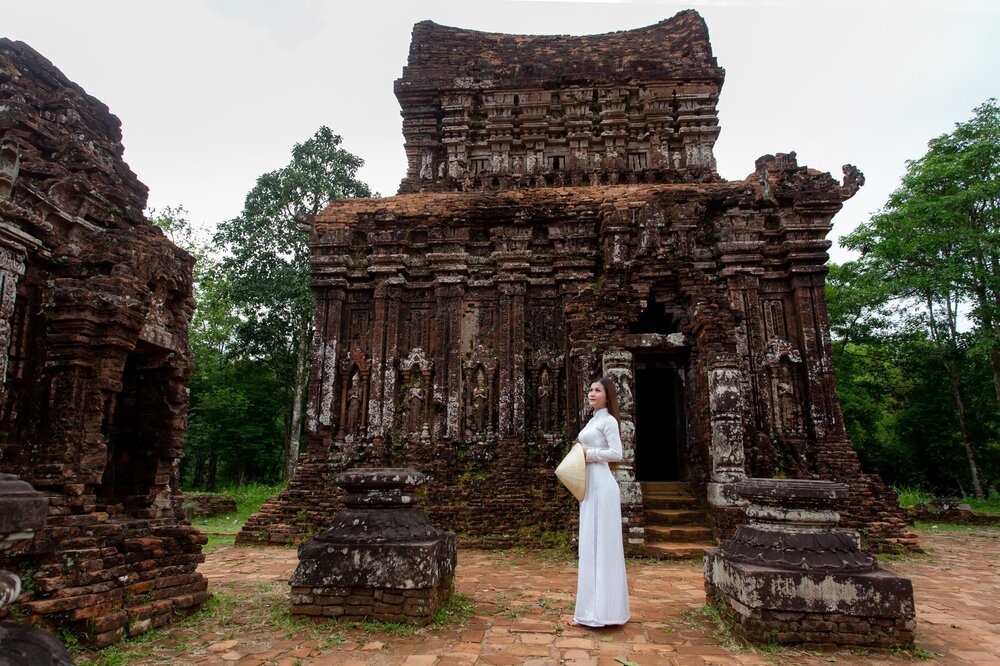
The morning: My Son Sanctuary, 40 km southwest of Hoi An. This is the largest surviving Cham temple complex in Vietnam — Hindu towers built between the 4th and 14th centuries in a jungle valley ringed by mountains. Much of the site was bombed in 1969 and some groups are largely rubble, but Groups B, C, and D are intact enough to be worth the trip, and the setting in the valley is genuinely striking. Tours leave from Hoi An hotels from around 8am and return by early afternoon.
The afternoon is for the things you didn’t get to yesterday — the Cam Thanh coconut forest boat ride, a bicycle ride to An Bang Beach (4 km east of the old town, with good seafood restaurants), or another slow walk through the old town at a different time of day. If you’re getting clothes made — Hoi An’s tailors are the main reason many people come — this is the day for a second fitting.
In the evening, take the overnight bus or train toward Nha Trang: the train from Da Nang departs at 23:03 and arrives in Nha Trang at 09:09.
Day 11
Nha Trang
Nha Trang is Vietnam’s most developed beach resort city, and it’s worth being clear about what that means. The beach is long and clean, the water is warm, the seafood is excellent, and the strip behind the beach is loud, hotel-dense, and heavily commercial. If you want a relaxed tropical beach day, this isn’t really it. If you want a place to recover from travel, swim, eat well, and not have to think too hard, it works fine.
The island-hopping boat trips are the most enjoyable thing to do here — the southern islands have clearer water for snorkelling than the main beach. Vinpearl Land on Hon Tre Island is the large resort-and-theme-park complex visible offshore; it’s worth it for families with children, less so for everyone else.
The Po Nagar Cham Towers on the northern headland are the city’s main historical site — a working temple complex that’s been in use since at least the 8th century, now sitting incongruously above a modern city. Worth an hour in the morning before the heat sets in.
Optional: Da Lat
If Nha Trang doesn’t appeal — and it doesn’t appeal to everyone — consider going inland to Da Lat instead. Vietnam’s “City of Eternal Spring” sits at 1,500 metres in the Central Highlands, with a noticeably cooler climate, pine forests, French colonial architecture, and an enormous wholesale flower market that supplies most of southern Vietnam. It’s a completely different atmosphere from the coast. The Crazy House (Hang Nga Villa) is the city’s famous oddity: a guesthouse designed by a Vietnamese architect trained in Moscow, shaped like a continuous tree with no straight lines or right angles. Adventure activities — canyoning, mountain biking, trekking — are well-organised here. A detour to Da Lat adds one to two days.
Day 12
The train from Nha Trang to Ho Chi Minh City at 09:16 arrives at 17:35 — a long day on the train but the coastal views for the first section are good. If you want an extra day in Nha Trang or did the Da Lat detour, overnight train options leave at 21:09 (arriving HCMC 05:15) or 21:44 (arriving 05:45).
If you arrive in the afternoon, go straight to your hotel, drop luggage, and head out for dinner. District 1 around Bui Vien Street and Pham Ngu Lao is the backpacker centre; Ben Thanh Market area has more local restaurants. The city is overwhelming on first arrival — it’s bigger, faster, and louder than anything else in Vietnam. Give yourself the evening to get oriented rather than trying to do anything specific.
Day 13
Ho Chi Minh City (Saigon)
Ho Chi Minh City doesn’t have a compact historic centre the way Hanoi or Hoi An does, so the best approach is to pick a few anchors and walk between them rather than trying to follow a structured route.
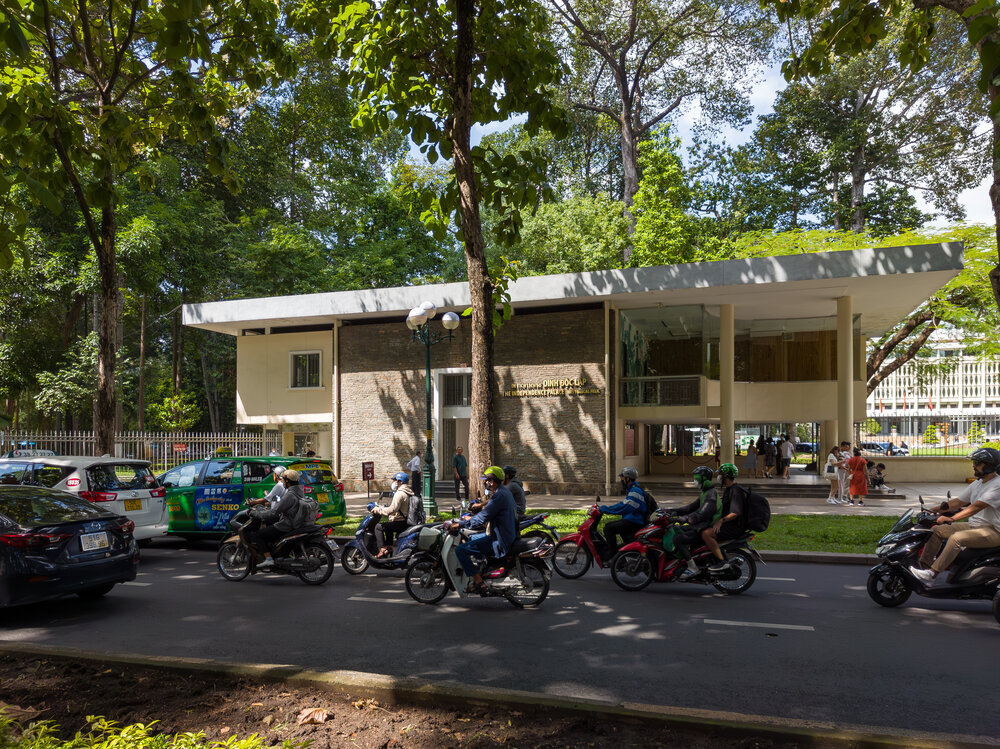
Start at the Reunification Palace — the former presidential palace of South Vietnam, frozen in time since April 30, 1975, when a North Vietnamese tank drove through the gates. The interior is still furnished as it was that day, including the war room with its operational maps in the basement. Allow two hours. The Central Post Office is a five-minute walk away: a Gustave Eiffel-era building still functioning as a post office, with a large map of Cochinchine on the wall and local people queuing at the counters.
The War Remnants Museum is a couple of kilometres northwest. It’s confronting — the photographic archive of the American War, the collection of weaponry and aircraft in the courtyard, the documented account of civilian casualties. It’s one-sided by design, but the photographs are real and the visit stays with you. Plan two hours.
Ben Thanh Market is useful for picking up food, coffee, and souvenirs in one place; the surrounding streets have better prices than inside the market itself. For dinner, try com tam (broken rice with pork, egg, and pickled vegetables) at a local restaurant — it’s the working Saigon lunch dish and the best versions are at small places with plastic chairs rather than restaurants with menus in English.
Day 14
Final day. Use the morning for what you didn’t get to yesterday: the District 1 neighbourhood south of Ben Thanh, with its mix of French colonial buildings and modern towers; the Jade Emperor Pagoda in District 3, an ornate Taoist temple filled with incense smoke and elaborate carved deities; or the Fine Arts Museum in a restored French villa near the riverfront.
If you have a late flight, the Cu Chi Tunnels are a half-day trip — the 200-km tunnel network used by Viet Cong fighters during the war, with sections widened for tourists to crawl through. Worth doing if you have the time. The Ben Duoc site (further from the city) is less touristed than Ben Dinh and better for the experience.
Alternatively: do nothing. Sit in a rooftop café somewhere above the city, drink Vietnamese coffee, watch the motorbike traffic below, and acknowledge that two weeks in Vietnam is enough to know you want to come back.
Optional: Mekong Delta
If you have extra time before leaving, the Mekong Delta is the most logistically straightforward addition to the itinerary. Can Tho is the largest city in the delta, four hours from HCMC by bus, and makes a good base. The Cai Rang floating market operates from 5am to around 8am — wholesale trading of fruit and vegetables between boats, with smaller boats weaving through selling coffee and noodles. It’s the most authentic remaining floating market in the region and worth the early start. A second day in the delta can take you further into the smaller towns and quieter waterways where the tourist infrastructure is minimal and the pace is genuinely slow.
Connect and book directly with local licensed tour operators at tour.vietnam-guides.com