
Last updated: October 2026
Da Lat is the one place in southern Vietnam where you’ll want a jacket. It sits at about 1,500 meters on the Lam Vien plateau, and while Ho Chi Minh City bakes at 34°C, Da Lat’s afternoons hover around 20–24°C and the nights get properly cold. That is the main reason to come, and it shapes everything else: the pine forests, the flower farms, the arabica coffee, the hotpot restaurants full of Vietnamese families in puffer jackets.
This guide covers the best things to do in Da Lat, what to eat, where to stay, how to get there (the airport reopened in August 2026 after a five-month closure) and a simple three-day plan.
My honest take: Da Lat in short
- How long: two nights is enough for the city, three if you want a canyoning day or a trip out to the waterfalls.
- Where to stay: walking distance from Xuan Huong Lake. The hills are pretty but you’ll need a Grab every time you go out.
- The one must-do: canyoning at Datanla if you’re even slightly adventurous. If not, the old train to Trai Mat and an afternoon in the cafes.
- Overrated: the Valley of Love. It’s a park of photo props; skip it unless that’s your thing.
- Timing trick: do outdoor things in the morning. From May to October the rain usually comes after lunch, and fog settles on Langbiang by early afternoon all year.
- Warning: Da Lat is packed on Vietnamese public holidays and Tet. Book hotels early or avoid those dates.
Some links below are affiliate links. If you book through them we may earn a small commission at no extra cost to you.
How many days do you need in Da Lat?
Two to three days. Day one covers the lake, the market and the Crazy House; day two the train to Trai Mat and the cable car out to Tuyen Lam Lake; day three is your adventure day (canyoning, Langbiang or the waterfalls south of town). If you’re coming for the cool air and the coffee, a slow fourth day costs very little and is easy to fill.
Best things to do in Da Lat
1. Walk around Xuan Huong Lake
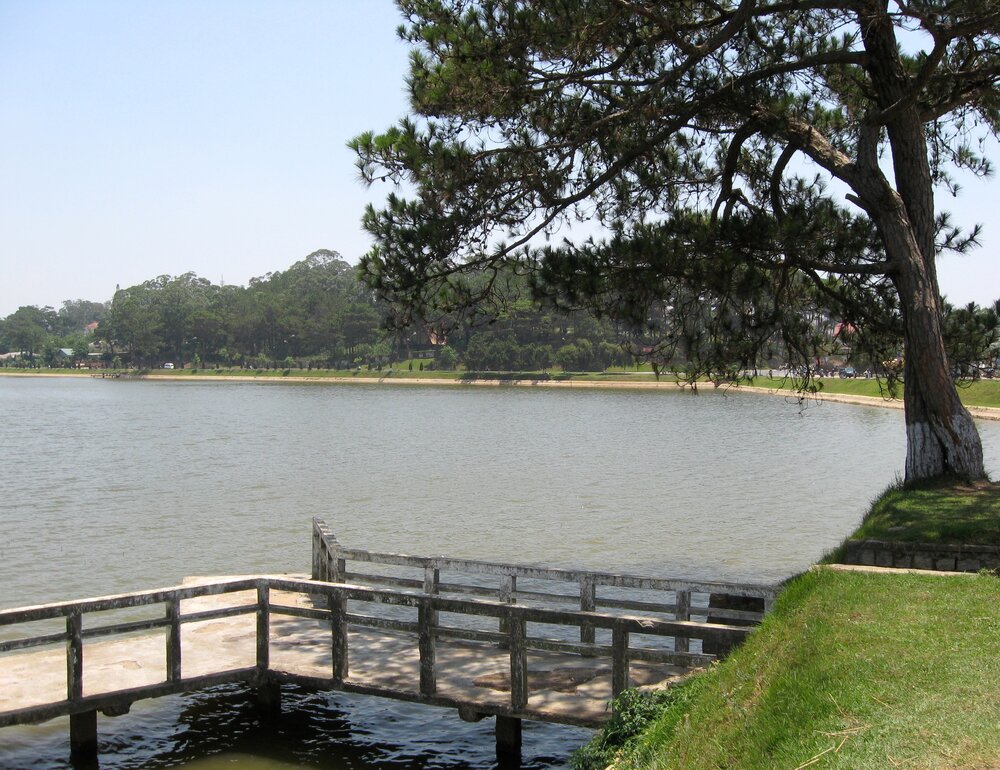
The lake in the middle of town is how Da Lat organizes itself; most of what you’ll want is within a 15-minute walk of its shore. The loop is about 5 km and takes an hour and a half at an easy pace. Go early, around 6–7am, when the mist is still on the water and locals are out exercising. You can rent swan pedal boats on the north side. The Da Lat Flower Gardens are at the northeast end if you want to add them.
More detail: Xuan Huong Lake guide
2. Go through the Crazy House
Hang Nga Guesthouse, known as the Crazy House, is a building by architect Đặng Việt Nga made of concrete tree trunks, spiral stairways, mushroom-shaped roofs and animal-themed rooms, linked by narrow bridges high above the garden. It’s open daily from 8:30am to 6pm and costs 80,000 VND (about $3) for adults (July 2026 price). The bridges are narrow and busy at midday, so go at opening. It’s also a working guesthouse; you can stay the night in one of the themed rooms.
More detail: Crazy House guide
3. Take the old train to Trai Mat
Da Lat Railway Station was built in the 1930s and is the prettiest station in Vietnam. The line to the coast closed decades ago, but a restored 7 km section still runs tourist trains to Trai Mat village. The trip takes about 30 minutes each way and tickets cost around 70,000–100,000 VND (about $3–4) per ride depending on the carriage. The train only leaves once roughly 20 passengers have bought tickets, so on quiet weekdays you may wait.
At Trai Mat, walk five minutes to Linh Phuoc Pagoda, which is covered almost entirely in mosaics made from broken pottery and glass. You usually get about 45 minutes before the train goes back.
4. Ride the cable car to Truc Lam and Tuyen Lam Lake
The Robin Hill cable car runs over the pine forest to Truc Lam Zen Monastery, a working monastery with neat gardens above Tuyen Lam Lake. Tickets start at about 120,000 VND (about $5) one way. It closes over lunch (roughly 11:30am to 1pm), so plan around that. From the monastery you can walk down to the lake for kayaking or a boat ride. Dress modestly for the monastery: shoulders and knees covered.
5. Climb (or drive) Langbiang
Langbiang Mountain, about 12 km north of the city, is the highest point around Da Lat at 2,167 m and is sacred to the K’Ho people who live at its base. Entry is about 40,000–60,000 VND, and a shared jeep to the lower viewpoint costs around 100,000–120,000 VND per person.
To hike, the short trail is about 2.5 km each way: one and a half to two hours up and an hour down. Hiking is only allowed in the morning (roughly 7am to 1pm) because fog comes in after lunch. A local K’Ho guide costs about 200,000 VND and is a good idea for the summit trail. Tandem paragliding flights also launch from here (see Adventure sports below).
6. See the waterfalls: Datanla, then Elephant Falls
Datanla Waterfall is 5 km south of town and the easiest to reach. The main draw is the alpine coaster, a 2,400 m track through the forest that drops you near the falls. Tickets run about $10 and it’s open roughly 7:15am to 4:30pm. Weekends get long queues.
Elephant Falls (Thác Voi), about 30 km southwest near Nam Ban, is bigger, wilder and far less crowded. The path down is steep and slippery, so wear shoes with grip. Many people combine it with Linh An Pagoda next door and a coffee farm on the way back.
7. Go canyoning at Datanla
This is Da Lat’s best adventure day. You abseil down waterfalls, slide down rock chutes and jump into pools, with a picnic lunch in the middle. A full day with gear, guides, lunch and hotel pickup costs around 1,590,000 VND (about $61) with local operators, and $65–90 on booking sites. Book with a licensed operator that includes insurance; very cheap offers are a red flag. The water is calmer in the dry season (December to April).
More detail: Da Lat canyoning guide
8. Visit a coffee farm
Da Lat grows arabica, which tastes lighter and less bitter than the robusta grown lower down in the Central Highlands. A farm visit with picking, roasting and tasting starts at about $10. It’s an easy half-day and usually combines well with the waterfalls south of town.
More detail: Da Lat coffee farm tour
9. Ride the “Mario Kart” at Cao Nguyen Hoa
The luge kart at Cao Nguyen Hoa, 10 km west of town on the Ta Nung pass, is the most fun hour you can have in Da Lat for 300,000 VND (about $12). Gravity karts with hand brakes roll down two forest tracks full of hairpins, a gentle 1.5 km green one and a steeper 1 km red one. You’re sent off in small groups, so it quickly turns into a race. The ticket includes park entry and one run on each track. Ticket sales stop at 4:30pm, so don’t leave it to the end of the day.
More detail: Mario Kart Da Lat guide
10. Skip (or don’t) the Valley of Love
The Valley of Love is a lake ringed by pine trees, but most of the space is flower displays and photo props built for couples and selfies. It’s very popular with Vietnamese visitors and very skippable for most foreigners.
Adventure sports in Da Lat
Canyoning is the big one (see above). After that:
- Tandem paragliding from Langbiang: about 1,900,000–2,500,000 VND (about $75–100) depending on how long you fly. The season is roughly November to May.
- Easy Rider tours: guided rides on the back of a local guide’s motorbike to coffee farms, flower greenhouses and minority villages, for a day or over several days to Nha Trang or Hoi An.
- Mountain biking through the pine hills and farmland, from easy half-days to full-day downhill routes.
- Kayaking and paddleboarding on Tuyen Lam Lake.
If you ride a motorbike yourself, the roads down to Phan Rang (Ngoan Muc Pass) or Nha Trang (Khanh Le Pass) are some of the best in the south, but they’re steep, foggy and busy with trucks. Only do them if you’re experienced and properly licensed. Rentals cost about 150,000–200,000 VND a day in town.
What to eat in Da Lat
Da Lat food is cold-weather food, built around the farms. The night market and the streets around Da Lat Market are the easiest place to try most of it.
Bánh tráng nướng: rice paper grilled over charcoal with egg, spring onion and dried shrimp, sold as “Vietnamese pizza”. Every corner of the night market has a stall.
Bánh căn: small rice-flour pancakes cooked in clay molds, dipped in fish sauce with meatballs.
Bánh mì xíu mại: pork meatballs in tomato broth with bread for dipping. The classic Da Lat breakfast.
Lẩu gà lá é: chicken hotpot with é leaves, a peppery local herb. Best for two or more on a cold evening.
Lẩu bò: Da Lat-style beef hotpot. The best-known version comes from the Ba Toa area, and Lẩu Bò Ba Toa has been serving it since 1996.
Sữa đậu nành nóng: hot soy milk from night stalls, with a few small cakes.
Kem bơ: avocado blended with ice and topped with coconut ice cream.
To take home: artichoke tea, strawberry jam and dried persimmons from Da Lat Market. Buy at the market rather than at the shops by attractions.
Where to stay in Da Lat
For a first visit, stay within walking distance of Xuan Huong Lake or Da Lat Market. The center is walkable, and the hills get cold and dark at night. Prices jump 30–50% on Saturday nights and over holidays.
Budget: guesthouses and hostels around Da Lat Market and Bui Thi Xuan and Truong Cong Dinh streets start at roughly 250,000–600,000 VND (about $10–25) a night.
Mid-range: boutique hotels and pine-hill homestays at roughly $35–80 a night. Many have fireplaces. Check how far the walk to the center is.
Terracotta Hotel & Resort: at Tuyen Lam Lake, about 7 km south of the center. Good if you want the lake and the forest; less good if you plan to eat in town every night.
Ana Mandara Villas Dalat: restored French villas with fireplaces on a hill about 4 km from the center. Typically $85–140 a night in autumn 2026.
Dalat Palace Heritage Hotel: the grand 1922 hotel overlooking the lake, the classic splurge.
Search hotels in Da Lat on Klook.
Best time to visit Da Lat
December to March is the best time for most people: dry, sunny days, cold nights (down to 10–12°C) and the most flowers. It’s also the busiest season for Vietnamese visitors, especially around Tet. April is warm and dry. May to October is the rainy season; it usually rains in the afternoon, mornings are often clear, prices are lower and the farms are at their greenest. Avoid Tet, 30 April–1 May and 2 September unless you’ve booked well ahead.
Read the month-by-month guides: January · February · March · April · May · June · July · August · September · October · November · December
How to get to Da Lat
| Route | Option | Time | Price (2026) |
|---|---|---|---|
| Ho Chi Minh City | Flight to Lien Khuong (DLI) | About 50 min | Varies by date |
| Ho Chi Minh City | Sleeper bus (Phuong Trang/FUTA) | 7–8 hours | About 250,000–300,000 VND ($10–12) |
| Ho Chi Minh City | Limousine van | About 7 hours | About 350,000–650,000 VND ($14–25) |
| Nha Trang | Bus or van over Khanh Le Pass | 3.5–4 hours | About 170,000–350,000 VND ($7–14) |
| Hanoi | Flight to DLI | About 1 hr 50 min | Varies by date |
By air. Lien Khuong Airport (DLI) is 30 km south of the city. It was closed from March to August 2026 for runway work and reopened on 19 August 2026. Vietnam Airlines and Vietjet fly from Ho Chi Minh City, Hanoi and Da Nang, plus Hai Phong, Vinh and Can Tho. AirAsia flies from Kuala Lumpur. A Grab or taxi into town costs about 250,000–350,000 VND (about $10–14) and takes 35–45 minutes. There’s a cheaper airport shuttle (around 40,000–50,000 VND), but it has run on and off recently, so don’t rely on it after dark.
By bus. From Ho Chi Minh City, overnight sleeper buses save you a hotel night but you’ll arrive tired around dawn. Limousine vans are faster and more comfortable. From Nha Trang the road climbs over the Khanh Le Pass, the most scenic way in. A landslide closed it in late 2025; it’s open again, but in heavy rain (October–November) check with your bus company first. Book on Vexere or 12Go.
By train. There’s no train to Da Lat. The nearest main-line station is Nha Trang.
More on getting around: Vietnam transportation guide
Sample 3-day Da Lat itinerary
Day 1: the center. Sunrise walk around Xuan Huong Lake, bánh mì xíu mại for breakfast, the Crazy House at opening, lunch, Da Lat Railway Station and the train to Trai Mat and Linh Phuoc Pagoda in the afternoon. Night market and bánh tráng nướng for dinner.
Day 2: adventure. Full-day canyoning at Datanla, or Langbiang in the morning (hike before the fog) and a coffee farm in the afternoon. Hotpot for dinner.
Day 3: lakes and falls. Robin Hill cable car to Truc Lam Zen Monastery, walk down to Tuyen Lam Lake, then Elephant Falls and Linh An Pagoda in the afternoon by Grab or with a driver.
Want more options? See Da Lat itinerary ideas.
Planning a trip to Da Lat? We arrange private guided tours — day trips, multi-day itineraries, and custom routes.
Good to know before you go
Pack warm: nights drop to 10–15°C, and most hotels and homestays have no heating. A fleece or light down jacket is enough.
Getting around: the center is walkable. For anything further, use Grab (car or motorbike). There’s no useful city bus network.
Cash: ATMs are easy to find in the center, but night market stalls and small restaurants are cash only.
Fog and roads: mountain roads into Da Lat get foggy in the late afternoon and evening. Avoid riding or driving them after dark.
Holidays: on Tet and long weekends, hotel prices can double and the lake and market are packed.
Visas: most nationalities need an e-visa. See our Vietnam e-visa guide.
Is Da Lat worth visiting?
Yes, if you want a break from the heat, good coffee, cheap adventure sports and a slower few days between the beaches and the big cities. It isn’t a place of big monuments, and some of its attractions are built for selfies rather than sightseeing. If you only have a week in Vietnam, you can leave it out. If you have two weeks or more and you’re traveling through the south, it’s an easy and cheap detour, and the canyoning alone makes it worth the trip for a lot of people.
Frequently asked questions
Is Da Lat worth visiting?
Yes, especially if you’re spending two weeks or more in Vietnam and want cool weather, coffee and outdoor activities like canyoning. Skip it if you only have a week and want the classic highlights.
How many days do you need in Da Lat?
Two to three days. Two covers the lake, the Crazy House, the train to Trai Mat and the cable car; a third day is for canyoning, Langbiang or the waterfalls.
What is the best month to visit Da Lat?
December to March, for dry, sunny days and the most flowers in bloom. Book early around Tet. The rainy season (May to October) is quieter and cheaper, with clear mornings.
How do I get from Ho Chi Minh City to Da Lat?
Fly into Lien Khuong airport (about 50 minutes; it reopened on 19 August 2026) or take a sleeper bus or limousine van (7–8 hours, from about 250,000 VND, roughly $10).
Is Da Lat cold?
Cool rather than cold. Days are around 20–24°C, but nights drop to 10–15°C, especially from December to February, and most rooms have no heating. Bring a warm layer.
Is it safe to go canyoning in Da Lat?
Yes, with a licensed operator that provides proper gear, trained guides and insurance. Avoid the cheapest offers, and don’t go after heavy rain when the water is high.